


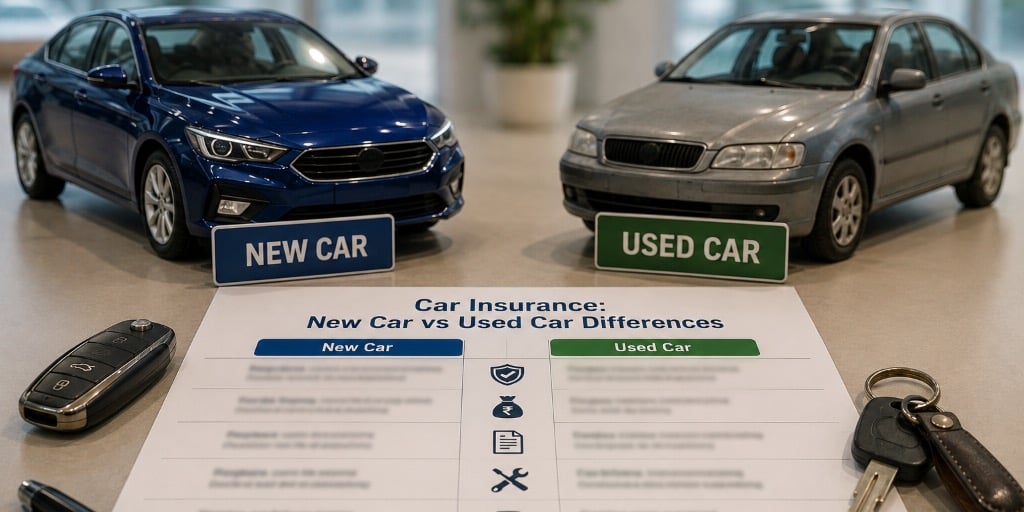
Buying a used car feels like the value-conscious choice. Then insurance enters the picture, and the rules look different. The car insurance new car vs used car gap is small. But the differences in IDV, premium, add-ons, and transfer can quietly cost you money. This guide is for the buyer in the middle of that decision. It explains why used car insurance works the way it does, how IDV is set, how the premium compares, which add-ons earn their place, and what to do about transfer on day one.
Why Used Car Insurance Works Differently from New Cover
The principle of motor insurance is the same for any car, new or used. But the inputs the insurer uses look different. A new car carries a high invoice price and near-perfect condition. A used car insurance quote reflects depreciation, some wear, and an ownership history.
That is why the car insurance new car vs used car comparison shows up in three places: the IDV, the premium calculation, and the buying process itself. A new car gets its IDV pegged close to the ex-showroom price, with long-term third-party cover locked in for three years. A used car gets a depreciated IDV, may need a pre-inspection if the previous policy lapsed, and starts the NCB clock fresh in the new owner's name. None of this makes used car insurance worse. It simply makes it a different product priced for a different risk profile.
How IDV Used Car Calculations Actually Work
The Insured Declared Value is the maximum your insurer will pay if your car is stolen or written off. It is also the figure that most directly drives your premium. For a new car, the IDV starts at roughly the ex-showroom price minus a small first-year depreciation. For a used car, the maths picks up from where the previous owner left off.
IRDAI prescribes a standard depreciation chart that all insurers apply to the IDV used car calculation. The pattern looks like this:
| Car Age | Depreciation Applied |
|---|---|
| 6 months to 1 year | 15% |
| 1 to 2 years | 20% |
| 2 to 3 years | 30% |
| 3 to 4 years | 40% |
| 4 to 5 years | 50% |
| Over 5 years | Mutually agreed |
A four-year-old hatchback with an original price of Rs 7 lakh has an IDV used car figure of roughly Rs 4.2 lakh. The temptation is to ask for a low IDV simply to cut the used car insurance premium. Resist that. A low IDV saves a few hundred rupees today but shrinks your payout on a total loss claim.
Premium Gaps: Used Car Insurance vs New Car Insurance Cost
The headline number most buyers care about is the annual premium. Here the picture is encouraging for used car owners. A lower IDV translates almost directly into a lower own-damage premium. The third-party part stays identical to any other car of the same engine capacity, because IRDAI fixes that figure by cc.
A worked example helps. Take an identical model, one bought new and one bought four years used.
| Item | New Car (IDV Rs 7 lakh) | Used Car (IDV Rs 4.2 lakh) |
|---|---|---|
| Own damage premium | Rs 11,500 | Rs 7,800 |
| Third party premium | Rs 3,416 | Rs 3,416 |
| Total before NCB | Rs 14,916 | Rs 11,216 |
So the used car owner pays roughly Rs 3,700 less per year. Over five years, that is meaningful money. The No Claim Bonus a careful driver builds up adds to the saving.
That is where the question of is insurance costlier for old cars sometimes confuses buyers. In absolute financial terms, used car insurance is almost always cheaper. What does rise slightly is the premium as a percentage of IDV, because insurers see ageing cars as marginally higher-risk for breakdown and electrical issues. The total rupee outlay still drops year on year.
Add-ons Worth Paying For on Your Used Car Insurance
The full add-on menu available on a new car is rarely sensible on a used one. The trick is knowing which ones still earn their place.
- Zero depreciation: Usually available for cars up to five years old, and worth buying if your car qualifies. It removes the depreciation cut on plastic, rubber, and fibre parts during a claim.
- Engine protection: Strongly recommended in flood-prone cities. The base policy does not cover water damage to the engine, and an older engine is more vulnerable to hydrostatic lock.
- Roadside assistance: Modest in cost, generous in value, and especially useful on a car you do not yet know well.
- Consumables cover: Pays for engine oil, nuts, bolts, and brake fluid during a claim. On older cars these items genuinely add up.
- NCB protect: Only relevant if you are carrying a bonus across from a previous car. If you are starting fresh, skip it.
Return to invoice is the big exception. It pays the original invoice value on total loss, which is powerful on a new car but largely meaningless on a used one. Skip it and put the money into engine protection instead.
Transferring Insurance for Second Hand Car Buyers
Insurance for second hand car ownership is not optional paperwork. It is a fourteen-day deadline set by the Motor Vehicles Act, and missing it can void your cover. You have two clear routes.
From Seller: Transferring the Existing Policy
If the seller's policy has meaningful time left and the add-ons broadly match what you want, transfer their existing policy into your name.
- Complete the RC transfer at the RTO first.
- Contact the insurer within 14 days of the transfer.
- Submit the new RC copy, your ID proof, and the policy document.
- Pay the transfer fee, typically Rs 50 to Rs 200.
The cover continues seamlessly, but the seller's NCB does not come with it. The bonus belongs to the person, not the car.
Fresh Policy: Buying New Cover
The alternative is to let the seller's policy lapse and buy fresh in your name. You then pick your own insurer, IDV, and add-ons. A pre-inspection may be needed if the existing policy has already expired. For a recently insured car, it is usually straightforward. This route is almost always better when the seller's policy is third-party-only cover.
Final Thoughts on Used Car Insurance
The car insurance new car vs used car comparison comes down to four realities. The IDV is lower, the premium is lower, the add-on menu is narrower, and the transfer paperwork is non-negotiable. Get those four right and used car insurance becomes one of the easier decisions in the buying process.
If you are within 14 days of purchase, prioritise the transfer or fresh policy decision today. If you have time to compare, hold the IDV constant and check three insurers on premium, claim settlement ratio, and garage network.
Note: This article has been vetted by Siddarth Khandelwal, an Insurance expert at Insure24.
FAQs
Q. Do I need insurance for a used car as soon as I buy it?
Yes, you do need insurance for a used car from the moment you take delivery, because driving uninsured is illegal under the Motor Vehicles Act. Either transfer the seller's existing policy into your name within 14 days, or buy a fresh policy on day one. There is no grace period for new ownership.
Q. Is insurance costlier for old cars in rupee terms?
No, in absolute financial terms, used car insurance is almost always cheaper than new car insurance costs. The IDV is lower, and the own damage premium falls in proportion. What does rise slightly is the premium as a percentage of IDV, since insurers price older cars as marginally higher-risk for mechanical and electrical issues.
Q. How is the IDV used car figure calculated?
The IDV used car figure starts from the ex-showroom price and applies IRDAI's standard depreciation chart based on age. A one-year-old car loses 15%, a four-year-old car loses 40%, and so on. The insurer also factors in make, variant, and local market value, which is why the final IDV can vary slightly between providers.
Q. What is the car insurance new car vs used car premium difference?
The car insurance new car vs used car premium difference is driven almost entirely by the IDV. A used car's lower insured value reduces the own damage component, while the third-party portion stays identical because IRDAI fixes it by engine capacity. Expect a four-year-old car to cost roughly 25% to 30% less in annual premium.
Q. Does the seller's No Claim Bonus transfer with the car?
No, the No Claim Bonus belongs to the person, not the car. The seller carries their bonus to their next vehicle while you start fresh from zero. If you previously owned a car and retained an NCB certificate, you can apply that to your new used car, but the seller's bonus is never transferable to you.
Q. Is insurance for second hand car ownership mandatory in India?
Yes, insurance for second hand car ownership is fully mandatory from the day of purchase, under the same Motor Vehicles Act rules that apply to any vehicle on Indian roads. You have 14 days to either transfer the existing policy into your name or arrange a fresh policy, and driving uninsured invites fines and seizure.
Q. Should I buy a comprehensive plan on an older used car?
For cars up to ten years old, comprehensive cover usually still earns its place because repair costs remain high and theft risk does not fall with age. Beyond ten years, with a low IDV and minor resale value, many owners switch to a third-party-only plan. The decision depends on how much your specific car is still worth.
Q. What pre-inspection is needed when transferring used car insurance?
A pre-inspection is needed only if the previous policy has already lapsed for more than the grace period, or if you are buying a fresh cover on a car whose previous cover expired. A surveyor or app-based self-inspection records the car's condition, after which the new cover begins, usually within a few hours of approval.
Q. Can I add zero depreciation to a used car policy?
Yes, you can add zero depreciation to a used car policy if the car is up to five years old, and it is almost always worth doing. Used cars accumulate damage faster on plastic and rubber parts, and zero depreciation removes those depreciation cuts during a claim, putting significantly more money back in your pocket per settlement.
Q. What happens if I do not transfer the policy within 14 days?
If you do not transfer within 14 days, the cover remains in the seller's name. Any claim you raise can be rejected on ownership grounds. The fix is to contact the insurer at once and complete the transfer late, paying any penalty. Until then, you should not drive the car at all.
Q. Do I need insurance for a used car bought from Cars24 specifically?
Yes, you do need insurance for a used car from any source, including Cars24, Spinny, or any organised marketplace. The platform may hand you an existing policy or list one as active, but you must still verify the policy schedule, check the expiry, and complete the transfer or fresh policy paperwork within 14 days of delivery.
Q. How do I compare used car insurance quotes effectively?
Compare used car insurance quotes by holding the IDV, add-ons, and deductible constant across at least three insurers. The numbers then reflect genuine price differences and not different cover. Check the claim settlement ratio and network garage count alongside the premium, because a slightly cheaper policy from a weak insurer is rarely the better deal.












Licenced by

COMPANY
PRODUCTS
RESOURCES
LEGAL
Cars24 Financial Services Private Limited
(Wholly owned subsidiary of Cars24 Services Private Limited)
Corporate Office - 6th Floor, SAS Tower-C, Ch Baktawar Singh Road, Medicity Sector 38, Shivaji Nagar,
Gurgaon - 122001, Haryana
IRDAI Corporate Agency Registration No: CA0710 | Registration Validity: Perpetual |
CIN: U65990HR2018PTC075713
Disclaimer : The information contained in this website is presented purely for information purposes only provided as service to the internet community at large. It does not constitute insurance advice and we do not guarantee the accuracy, adequacy or the completeness of the information contained here.


Licenced by
COMPANY
PRODUCTS
RESOURCES
LEGAL
Cars24 Financial Services Private Limited
(Wholly owned subsidiary of Cars24 Services Private Limited)
Corporate Office - 6th Floor, SAS Tower-C, Ch Baktawar Singh Road, Medicity Sector 38, Shivaji Nagar,
Gurgaon - 122001, Haryana
IRDAI Corporate Agency Registration No: CA0710
Registration Validity: Perpetual
CIN: U65990HR2018PTC075713
Disclaimer : The information contained in this website is presented purely for information purposes only provided as service to the internet community at large. It does not constitute insurance advice and we do not guarantee the accuracy, adequacy or the completeness of the information contained here.