


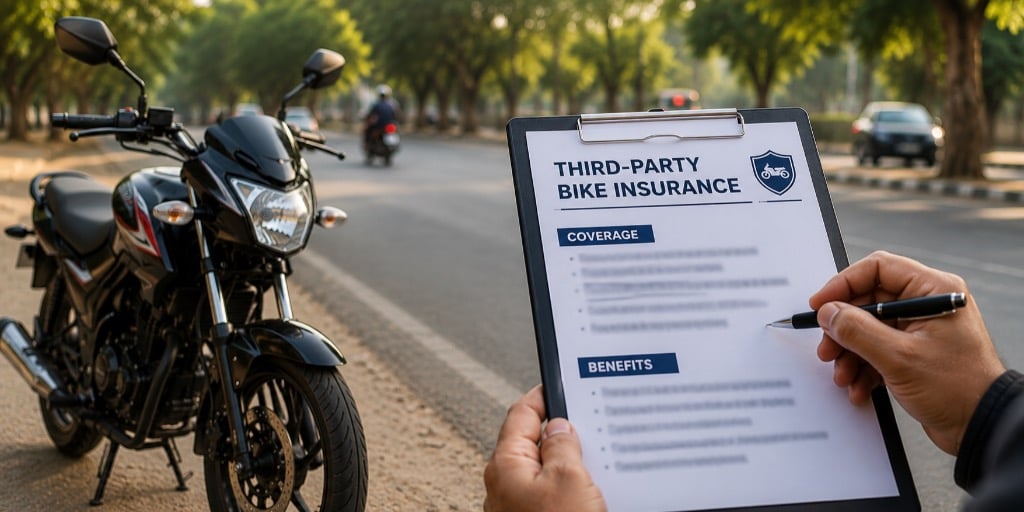
Here is a number that surprises most riders: the cheapest legal cover for your bike can cost less than a single tank of petrol a year. That is third-party bike insurance, the bare minimum the law asks you to carry. It will not pay a rupee to fix your own bike, but it keeps you legal and shields you from a bill that could run into lakhs if you hurt someone on the road. This is a simple guide to what it covers, what it costs, and when it is enough in plain words.
What is Third-Party Bike Insurance and Why IRDAI Makes it Non-Negotiable
Let us start with the basics. Third-party bike insurance covers the harm or damage you cause to someone else with your bike: another person, their vehicle, or their property. It does not cover your own bike at all. The third party is the other person, you are the first, and the insurer is the second.
Under the Motor Vehicles Act, every bike on a public road must carry at least this cover. It is not optional, and it sets the bike insurance minimum cover that every rider must legally hold. Riding without it can mean a fine of 2,000 rupees for a first offence, more for a repeat, and even a short jail term in some cases. The reason the law is strict is fairness. If your bike injures someone or wrecks their property, that person deserves to be paid, whether or not you can afford it. That is why IRDAI, the insurance regulator, makes third party two wheeler insurance the non-negotiable floor that every rider must stand on.
Third-Party Premium Rates for Two-Wheelers by Engine CC (IRDAI Table)
The best thing about this cover is that the price is fixed by IRDAI and identical across every insurer. No company can charge more or less, so there is nothing to haggle over on the third-party part. The rate depends only on your bike's engine size. The table below shows the indicative yearly rates.
| Engine size | Indicative yearly third-party premium |
|---|---|
| Up to 75cc | Around 538 rupees |
| 75cc to 150cc | Around 714 rupees |
| 150cc to 350cc | Around 1,366 rupees |
| Above 350cc | Around 2,804 rupees |
To put that in real terms, a Honda Activa, a Hero Splendor, and a Bajaj Pulsar 150 all sit in the 75cc to 150cc band, so each pays around 714 rupees a year for third party bike insurance. A bigger Bajaj Pulsar 220 jumps to the 150cc to 350cc band at around 1,366 rupees. The bigger and more powerful the bike, the higher the fixed rate, since a larger bike carries more risk on the road. Electric bikes are priced differently, by motor power in kilowatts, and usually get a discount.
What Third-Party Bike Insurance Covers
It helps to know exactly what you are buying. This cover is narrow but important, and it pays out in three main ways.
Third-Party Bodily Injury
If your bike injures or causes the death of another person, this cover pays the compensation, which is decided by a Motor Accident Claims Tribunal. There is no upper cap on this part, so even a very large injury claim is covered. This is the single biggest reason the cover exists, since injury claims can run into many lakhs.
Property Damage Limit
If your bike damages someone else's vehicle or property, this cover pays for the repair, up to a limit of 1 lakh rupees. So a dented car door or a broken gate caused by your bike is covered within that cap.
Personal Accident Cover for Owner-Driver
The law also requires a personal accident cover for you, the owner-rider. It pays up to 15 lakh rupees for accidental death or permanent disability. You must hold this, either bundled with your third party two wheeler insurance or as a separate, standalone policy.
What Third-Party Bike Insurance Does Not Cover
This is the part many riders miss, and it leads to disappointment at claim time. Third-party cover is narrow, so it leaves out a lot.
- Any damage to your own bike, from accidents, theft, fire, or anything else.
- Theft of your bike, which is never covered under third-party.
- Damage from natural events like floods or storms to your own bike.
- Damage when riding without a valid licence or under the influence.
- Your own injuries beyond the owner-driver personal accident cover.
The simple takeaway is that third party insurance for bike owners protects other people, not your own machine. If your bike is stolen or damaged, you pay for it yourself. That gap is exactly why most riders with a bike of any real value step up to comprehensive cover.
Third-Party vs Comprehensive Bike Insurance: Cost-Benefit at Different Bike Ages
Here is the choice that really matters, and it comes down to your bike's age and value. The difference between third party and comprehensive bike insurance is simple: third-party covers only others, while comprehensive covers your own bike too, for a higher premium.
For a brand-new or fairly new bike, comprehensive cover makes clear sense. The cost of replacing it after a theft or a bad accident is high, so the extra premium buys real protection. For a very old bike worth very little, the own-damage part may not be worth paying for, so third-party alone can do the job and keep your costs down.
Think of it this way. On a sub-150cc commuter like a Splendor or Activa, third-party costs around 714 rupees, while full cover might cost a couple of thousand rupees a year. If the bike is new, that extra is worth it for the theft and accident protection. If the bike is ten years old and worth little, the bare third party bike insurance may be all you sensibly need. Match the cover to the value, and you never overpay or underprotect.
Long-Term Third-Party Policy for New Two-Wheelers: IRDAI Rules
If you have bought a brand-new bike recently, you will have noticed something. IRDAI rules require new two-wheelers to carry a long-term third-party policy, usually for five years, at the time of purchase. This was brought in so new bikes do not end up uninsured after a year when owners forget to renew.
This long-term third-party cover locks in the third-party part for five years, so you do not renew it annually. You can still buy or renew your own-damage cover separately each year if you want comprehensive protection, since the two parts were unbundled. The benefit is peace of mind: your legal cover cannot lapse for five years. The thing to remember is that this long-term policy covers only the third-party part, so your own bike still needs separate own-damage cover to be fully protected.
How to File a Third-Party Claim for Your Bike
A third-party claim works differently from an own-damage one, because the person claiming is usually the other party, not you. Here is how it flows.
If your bike injures someone or damages their property, the affected person files a claim, usually through a Motor Accident Claims Tribunal for injury cases. You should inform your insurer straight away and file a police FIR, since this is needed for third-party claims.
Share your policy details with the affected party and cooperate with the process. The insurer then handles the compensation up to the limits, unlimited for injury, and up to 1 lakh rupees for property damage. Keep your policy document, registration certificate, and driving licence ready, as these are needed to process any claim.
Third Party Bike Insurance Policy: Your Key To Legal Complaince
Third-party bike insurance is the cheap, simple floor that keeps you legal and shields you from the huge cost of hurting someone on the road. It is enough for a very old bike, but for anything with real value, the small step up to comprehensive cover is well worth it. Know the fixed rate for your engine size, hold your owner-driver cover, and match the cover type to your bike's worth. Get that right, and you ride legal and protected for one of the smallest costs of owning a bike.
Note: This article has been vetted by Siddarth Khandelwal, an Insurance expert at Insure24.
FAQs
Q. What is third party bike insurance and is it mandatory?
Third party bike insurance covers harm or damage you cause to others with your bike, like injury or property damage. It is the legal minimum under the Motor Vehicles Act, so every bike on the road must carry it. Riding without it can mean a fine and possible imprisonment.
Q. What is the third party bike insurance premium 2026?
The third party bike insurance premium for 2026 is fixed by IRDAI by engine size. It is around 538 rupees for bikes up to 75cc, 714 rupees for up to 150cc, 1,366 rupees for up to 350cc, and 2,804 rupees for above 350cc. The rate is the same across all insurers.
Q. Is third party bike insurance enough for my bike?
Third party bike insurance is enough only for a very old bike with little resale value. It keeps you legal but pays nothing for your own bike. For any bike with real value, comprehensive cover is the safer choice, since it protects against theft and accident damage too.
Q. What is the difference between third party and comprehensive bike insurance?
The difference between third party and comprehensive bike insurance is what they protect. Third-party covers only the harm you cause to others and is the legal minimum. Comprehensive adds cover for your own bike against accidents, theft, fire, and floods, for a higher premium.
Q. Does third party insurance for bike cover theft?
No. Third party insurance for bike owners never covers theft of your own bike, or any damage to it. It only pays for harm or damage you cause to others. To cover theft and damage to your own bike, you need comprehensive or standalone own-damage cover.
Q. What is the property damage limit under third-party cover?
Third-party cover pays for damage you cause to someone else's vehicle or property up to a limit of 1 lakh rupees. The bodily injury part has no upper cap, so injury claims are covered in full as decided by the tribunal.
Q. Is personal accident cover included in third-party bike insurance?
The owner-driver personal accident cover, which pays up to 15 lakh rupees, is a separate mandatory element. You must hold it, either bundled with your third party two wheeler insurance or as a standalone policy. It covers your own accidental death or permanent disability.
Q. Why is third-party insurance mandatory, but own-damage is not?
Because third-party cover protects other people, which is a public safety matter, the law makes it compulsory. Own-damage cover protects only your own bike, which is your personal choice. So the bike insurance minimum cover the law sets is third-party, with comprehensive left optional.
Q. How do IRDAI bike third party rates change?
The IRDAI bike third party rates are reviewed by the regulator from time to time, based on claims data and other factors. When they change, the new rate applies equally across all insurers, since IRDAI fixes this part. The own-damage premium, set by insurers, is separate.
Q. Can I buy only third-party cover for a new bike?
For a new bike, IRDAI requires a long-term third-party policy, usually five years, at purchase. You can ride on this alone to stay legal, but it leaves your own bike unprotected. Most owners add own-damage cover too for full protection against theft and accidents.
Q. How do I file a third-party claim?
The affected person usually files the claim, often through a Motor Accident Claims Tribunal for injuries. You should inform your insurer immediately, file a police FIR, and share your policy details. The insurer handles compensation up to the limits. Keep your policy, registration, and licence ready.
Q. Does the third party bike insurance premium differ by city?
No. The third party bike insurance premium is fixed by IRDAI by engine size and is the same across every city and insurer. Only the own-damage part of a comprehensive policy varies by city, since that part reflects local risk and is set by the insurer.








Licenced by

COMPANY
PRODUCTS
RESOURCES
LEGAL
Cars24 Financial Services Private Limited
(Wholly owned subsidiary of Cars24 Services Private Limited)
Corporate Office - 6th Floor, SAS Tower-C, Ch Baktawar Singh Road, Medicity Sector 38, Shivaji Nagar,
Gurgaon - 122001, Haryana
IRDAI Corporate Agency Registration No: CA0710 | Registration Validity: Perpetual |
CIN: U65990HR2018PTC075713
Disclaimer : The information contained in this website is presented purely for information purposes only provided as service to the internet community at large. It does not constitute insurance advice and we do not guarantee the accuracy, adequacy or the completeness of the information contained here.


Licenced by
COMPANY
PRODUCTS
RESOURCES
LEGAL
Cars24 Financial Services Private Limited
(Wholly owned subsidiary of Cars24 Services Private Limited)
Corporate Office - 6th Floor, SAS Tower-C, Ch Baktawar Singh Road, Medicity Sector 38, Shivaji Nagar,
Gurgaon - 122001, Haryana
IRDAI Corporate Agency Registration No: CA0710
Registration Validity: Perpetual
CIN: U65990HR2018PTC075713
Disclaimer : The information contained in this website is presented purely for information purposes only provided as service to the internet community at large. It does not constitute insurance advice and we do not guarantee the accuracy, adequacy or the completeness of the information contained here.