


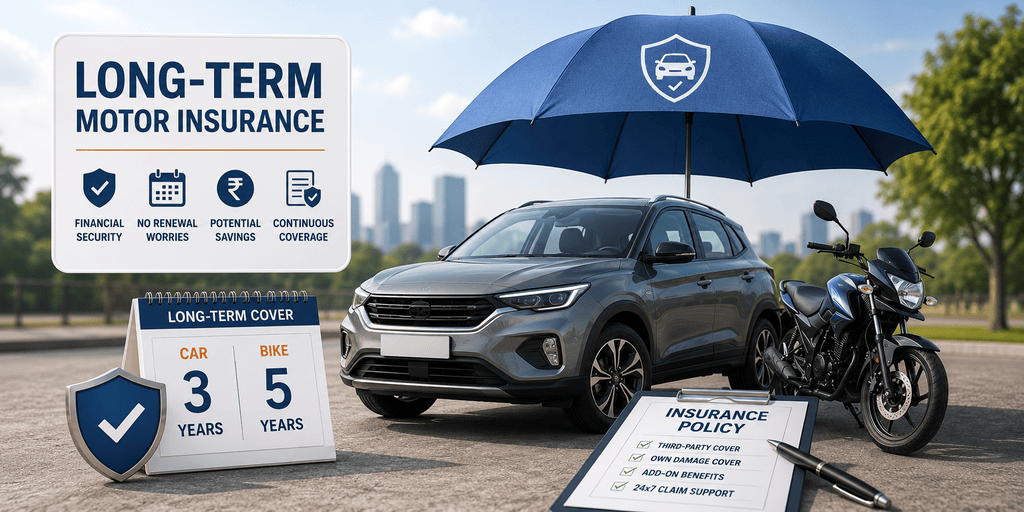
If you have bought a new car or bike in the last few years, you likely did not have a choice about long-term car insurance in India, at least not for the third-party portion. What you do have a choice about is everything else: whether to bundle own damage cover into that long-term period, whether to go annual instead once that window ends, and how much of a discount you are actually getting for locking in years of premium upfront. This guide walks through what long-term motor insurance actually means today, what the current mandate requires, and how to decide if it genuinely suits you.
What Is Long-Term Motor Insurance
Long-term motor insurance simply means buying cover for more than one year in a single transaction, rather than renewing annually. Any long-term car insurance India policy can apply to the third-party portion, the own damage portion, or both together as a bundled package policy. For cars, this typically means a three-year period. For two-wheelers, it typically means five years, though shorter multi-year options exist for own damage cover specifically.
The appeal is straightforward: fewer renewal cycles to track, one upfront payment instead of yearly transactions, and protection against a lapsed policy if you simply forget to renew on time. The trade-off is equally straightforward: a larger sum paid at once, and less flexibility to switch insurers or adjust coverage year to year based on how your circumstances change.
The Mandate for New Vehicles: Court Ruling and IRDAI Norms
The genesis of long-term motor insurance in India can be traced back to 2018. In July 2018, the Supreme Court of India directed that third-party cover for new cars must run for three years and third-party cover for new two-wheelers must run for five years, effective from September 2018. This mandate exists specifically to prevent the common problem of owners letting third-party cover lapse after the first year and unknowingly driving uninsured.
For a period after this ruling, insurers also bundled long-term own damage cover together with the mandatory long-term third-party cover into a single multi-year package policy, which is where the informal shorthand ‘3+3’ for cars comes from, referring to three years of both components together. In August 2020, IRDAI removed the requirement to bundle own damage with the mandatory long-term third-party cover, giving buyers the option to pair the mandatory multi-year third-party policy with an annual own damage policy instead, commonly shortened to ‘1+3’ motor insurance.
As things stand, the underlying mandate for long-term third-party cover, three years for new cars and five years for new two-wheelers, remains in effect and is a legal requirement under the Motor Vehicles Act. This rule has already been amended once by regulatory action, so check IRDAI's current circulars or your insurer directly before assuming this structure is permanently fixed, particularly since the Supreme Court has recently pushed IRDAI toward broader reforms of how motor policies are structured and communicated to buyers.
1+3 vs 3+3 vs Standalone Long-Term OD Cover
Understanding these three structures is the key to making a sensible choice at the time you buy a new vehicle. A 1+3 policy pairs the mandatory three-year third-party cover with an annual own damage policy that you renew every year, giving you the flexibility to adjust your own damage coverage, switch insurers on that portion, or apply a fresh No Claim Bonus discount each year, while the third-party portion simply runs its course untouched.
A 3+3 policy, sometimes offered as a genuinely bundled multi-year package, combines three years of both third-party and own damage cover into a single policy and a single upfront payment. This locks in your own damage premium rate for the full period, which protects you against future premium increases but also means you cannot easily switch insurers or adjust your own damage coverage before the three years are up.
Standalone long-term own damage cover is a third option, available separately from your mandatory long-term third-party policy, letting you choose a multi-year own damage term, commonly two or three years, that runs alongside but independently of your third-party cover. For two-wheelers, similar structures exist, generally described as 1+5 for annual own damage paired with the mandatory five-year third-party term, or a fully bundled 5+5 package.
How Long-Term Premiums Are Calculated
third-party premium within a long-term policy is simply the applicable annual IRDAI rate multiplied by the number of years, since this portion is fixed regardless of insurer. Own damage premium within a bundled long-term policy is calculated differently, since the insurer has to price in years of future risk and depreciation upfront rather than reassessing your vehicle's condition annually.
This is also where No Claim Bonus interacts differently with a bundled policy. Since a bundled multi-year own damage policy is priced once at the start rather than renewed annually, some structures apply a pre-calculated NCB-equivalent discount at purchase, while others handle NCB only at the point of renewal after the multi-year term ends. Ask your insurer explicitly how NCB is handled within a specific bundled product, since the mechanics differ enough between insurers to meaningfully affect your total cost.
Benefits of Long-Term Policies
The most obvious benefit is protection against a coverage gap. A single missed renewal reminder cannot leave you uninsured for years at a stretch, since the third-party portion simply continues running regardless. This matters given how common lapsed policies are among owners who renew annually and occasionally miss the deadline.
A genuinely bundled long-term policy also locks in your own damage premium rate against future price increases, a real saving if premiums rise industry-wide over your policy term. Long-term policies reduce the annual administrative hassle of renewal, and some insurers offer a modest discount for paying the full multi-year premium upfront rather than in yearly instalments.
Major Drawbacks and When to Avoid Them
The biggest drawback is reduced flexibility. If you find a better insurer or a more competitive own damage rate next year, a bundled long-term policy locks you in until the term ends, unlike an annual policy where you can simply switch at renewal. If your driving habits, city, or vehicle usage are likely to change significantly, an annual own damage policy paired with the mandatory long-term third-party cover generally makes more sense than a fully bundled package.
Long-term policies also require a larger upfront payment, a real consideration if cash flow matters more to you than long-term convenience. If you actively shop for better rates every year, a 1+3 structure that keeps own damage cover annual while satisfying the mandatory third-party requirement is usually the better fit.
Premium Comparison: Annual vs Long-Term
| Approach | Upfront Cost | Flexibility | Protection from Premium Hikes | Renewal Effort |
|---|---|---|---|---|
| Annual (1+1, renewed yearly) | Lowest | Highest | None | Every year |
| 1+3 (annual OD, 3-year TP) | Moderate | High on OD portion | None on OD, locked on TP | Every year for OD only |
| 3+3 (fully bundled) | Highest | Lowest | Full protection for 3 years | None for 3 years |
Note that this is illustrative rather than an exact quote for any specific vehicle, since actual figures depend heavily on your car or bike's IDV, city, and insurer, but the trade-off pattern holds consistently: more bundling means less flexibility and more upfront cost, in exchange for fewer renewal cycles and rate protection.
NCB Accumulation in Long-Term Policies
No Claim Bonus works cleanly under an annual own damage policy: one claim-free year earns a discount at the next renewal, building up to a maximum of 50 per cent over five consecutive years. Under a genuinely bundled multi-year own damage policy, NCB accumulation is less straightforward, since there is no annual renewal event to apply a fresh discount at.
Some insurers address this by baking an assumed NCB progression into the upfront bundled price, while others simply apply your accumulated NCB at the end of the multi-year term when you renew again. If preserving clear, year-by-year NCB tracking matters to you, particularly if you expect to stay claim-free and want the discount reflected as soon as possible, a 1+3 structure with annual own damage renewal generally offers cleaner NCB mechanics than a fully bundled 3+3 policy.
Can You Cancel or Port a Long-Term Policy Mid-Term
Third-party cover within a mandatory long-term policy generally cannot be cancelled outright, since continuous third-party cover is a legal requirement for any registered vehicle, though it can be transferred if you sell the vehicle. Own damage cover within a bundled long-term policy can usually be cancelled mid-term, but this typically comes with a short-period refund calculation that returns less than a simple pro-rata share of your unused premium, since insurers apply their own short-term rate scales to early cancellations.
Porting a long-term policy to a new insurer mid-term is possible but less common than porting an annual policy, since the administrative and refund mechanics are more complex once years of premium are already paid upfront. If you anticipate switching insurers within the policy term, this favours the 1+3 structure over a fully bundled 3+3 policy from the outset.
How to Buy a Long-Term Policy Online
Buying a long-term policy for a new vehicle typically happens automatically through your dealership or directly through the insurer at purchase, since the long-term third-party component is mandatory. To buy or compare separately, visit the insurer's website or a platform like Insure24, enter your vehicle details, and select your preferred structure: either a fully bundled multi-year package or the mandatory long-term third-party paired with an annual own damage policy.
Compare the total cost of a bundled option against the annual own damage route projected over the same number of years, factoring in the flexibility difference, before committing to the larger upfront payment. Complete payment online, and you should receive your policy documents by email, with clear terms on how each component of your cover is structured and when it is due for renewal.
Which Owners Should Choose Long-Term Cover
Owners who value simplicity and are unlikely to shop around each year tend to benefit most from a fully bundled long-term policy, since it removes renewal hassle for the length of the term. Owners who expect their circumstances to change, such as moving to a new city, a better own damage rate elsewhere, or a desire to actively manage their No Claim Bonus year by year, are usually better served by the 1+3 structure that keeps own damage annual while satisfying the mandatory long-term third-party requirement.
There is no universally correct answer here, and the right choice for long-term car insurance in India depends more on how much you value flexibility versus convenience than on any fixed rule about which structure is objectively cheaper over time. A 1+3 year insurance policy suits most owners who want to satisfy the mandate without losing annual flexibility on the own damage side.
FAQs
Q. Is long-term insurance mandatory for a new car in India?
Yes, for the third-party portion specifically. New cars require a mandatory three-year third-party policy, while own damage cover can be either bundled into that term or purchased annually instead.
Q. What are the benefits of multi-year bike insurance specifically?
It satisfies the mandatory five-year third-party requirement in one transaction, reduces the risk of a lapsed policy, and can lock in your own damage premium rate if you choose a bundled option.
Q. Long-term vs annual car insurance: which is better overall?
Neither is universally better. Long-term suits owners who prioritise convenience and rate protection, while annual own damage cover suits owners who want flexibility to switch insurers or adjust coverage every year.
Q. Can I cancel long-term car insurance mid-term?
The mandatory third-party portion generally cannot be cancelled while the vehicle remains registered and in use, though own damage cover within a bundled policy can usually be cancelled, typically with a reduced short-period refund.
Q. What is a 3 year comprehensive car insurance policy exactly?
It is a fully bundled long-term policy combining three years of third-party liability and three years of own damage cover into one upfront premium, sometimes referred to informally as a 3+3 structure.
Q. Does a 5-year bike insurance policy always include own damage cover?
Not necessarily. The five-year mandate applies specifically to third-party cover. Own damage cover can be bundled into that same five-year term or purchased separately as an annual policy.
Q. Does No Claim Bonus work differently under a long-term policy?
Yes, since there is no annual renewal event to apply a fresh discount. Insurers handle this differently, some building an assumed NCB progression into the upfront price, others applying it only when the term ends.
Q. Can I switch insurers with a long-term policy still active?
It is possible but less straightforward than switching an annual policy, since years of premium have already been paid upfront, which makes the refund and porting process more complex.
Q. Is a 1+3 structure cheaper than a fully bundled 3+3 policy?
Not necessarily cheaper overall, but it requires a smaller upfront payment and offers more flexibility, since only the mandatory third-party portion is locked in for three years while own damage renews annually.
Q. How do I know if my new vehicle already has long-term third-party cover?
Check your policy document for the third-party cover period specifically. If you bought a new car or two-wheeler recently, this portion is very likely already locked in for three or five years, respectively, even if your own damage cover renews annually.












Licenced by

COMPANY
PRODUCTS
RESOURCES
LEGAL
Cars24 Financial Services Private Limited
(Wholly owned subsidiary of Cars24 Services Private Limited)
Corporate Office - 6th Floor, SAS Tower-C, Ch Baktawar Singh Road, Medicity Sector 38, Shivaji Nagar,
Gurgaon - 122001, Haryana
IRDAI Corporate Agency Registration No: CA0710 | Registration Validity: Perpetual |
CIN: U65990HR2018PTC075713
Disclaimer : The information contained in this website is presented purely for information purposes only provided as service to the internet community at large. It does not constitute insurance advice and we do not guarantee the accuracy, adequacy or the completeness of the information contained here.


Licenced by
COMPANY
PRODUCTS
RESOURCES
LEGAL
Cars24 Financial Services Private Limited
(Wholly owned subsidiary of Cars24 Services Private Limited)
Corporate Office - 6th Floor, SAS Tower-C, Ch Baktawar Singh Road, Medicity Sector 38, Shivaji Nagar,
Gurgaon - 122001, Haryana
IRDAI Corporate Agency Registration No: CA0710
Registration Validity: Perpetual
CIN: U65990HR2018PTC075713
Disclaimer : The information contained in this website is presented purely for information purposes only provided as service to the internet community at large. It does not constitute insurance advice and we do not guarantee the accuracy, adequacy or the completeness of the information contained here.