


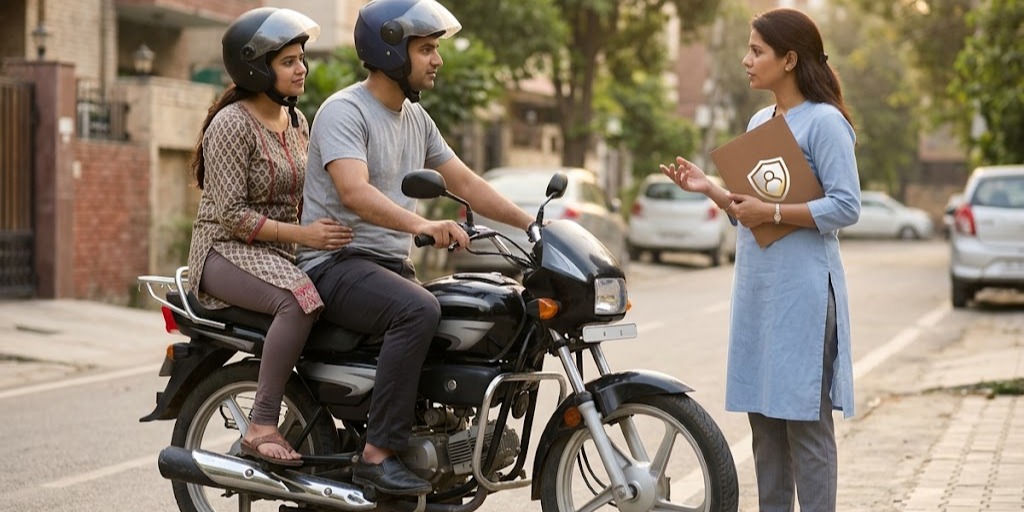
The pillion rider is not covered the way the rider is. Every bike owner who rides their own bike must hold compulsory personal accident cover of ₹15 lakh, but the person on the back seat gets no automatic personal accident cover at all. What a pillion rider cover in bike insurance adds is a fixed payout if the passenger dies or is permanently disabled in an accident, whoever caused it.
There is one layer of protection most riders do not know about. A comprehensive, or package, policy covers the owner's legal liability if the pillion is injured, so the insurer pays compensation a tribunal awards. A liability-only policy does not. Understanding the gap between these two kinds of protection is what decides whether passenger cover is worth adding.
Does Standard Bike Insurance Cover the Pillion Rider by Default
The short answer is partly, and only on a comprehensive policy. Here is how protection for the pillion differs by policy type.
| Policy type | Owner's liability if the pillion is injured | Fixed payout for pillion death or disability |
|---|---|---|
| Liability-only (third-party) policy | Not covered | Not covered, unless passenger cover is added where the insurer offers it |
| Comprehensive (package) policy | Covered | Not covered, unless passenger cover is added |
| Comprehensive policy with passenger cover | Covered | Covered up to the chosen sum insured |
| Any private policy, pillion carried for a fare | Not covered, since hire or reward is excluded | Not covered |
Where the Liability Cover Comes From
The Insurance Regulatory and Development Authority of India (IRDAI) issued a circular on 16 November 2009 confirming that insurers are liable for a pillion rider on a two-wheeler under a comprehensive or package policy. Insurers accepted this position before the Delhi High Court later in 2009, and the Supreme Court relied on it in National Insurance Co. Ltd. v. Balakrishnan (2012), a case about car occupants under the same principle.
On 4 August 2026, in National Insurance Co. Ltd. v. Thungala Dhana Laxmi, the Supreme Court again relied on the 2009 circular. It described a liability-only policy, often called an Act-only policy, as covering third parties but not the occupants of the insured vehicle, and a comprehensive policy as extending to them. The same judgment directed a four-layer policy structure at the point of sale, with a separate optional layer for pillion and occupant liability. IRDAI's detailed rules for that structure were awaited at the time of this update.
Why Liability Cover Is Not the Same as Pillion Cover
Liability cover pays only when the owner is legally liable, typically because the rider was at fault. The pillion or their family must usually file a claim before a Motor Accident Claims Tribunal (MACT), the court that decides road accident compensation, and wait for an award. If another vehicle caused the crash, the claim lies against that vehicle's insurer instead.
Pillion rider personal accident cover works differently. It pays a fixed amount directly, whoever caused the accident, once death or permanent disability is established.
Two Accidents, Two Outcomes
Consider a comprehensive policy with pillion cover of ₹1 lakh.
- The rider skids on a wet road and the pillion loses a leg. No other vehicle is involved. The passenger cover pays 50% of the CSI, ₹50,000, once the disability is certified. Any larger compensation depends on a tribunal claim against the owner's own policy, which turns on whether the rider was negligent.
A truck hits the bike and the pillion dies. The passenger cover pays the full ₹1 lakh to the nominee or legal heir. The family can separately claim compensation before the tribunal from the truck's insurer, since that vehicle caused the accident.
In both cases, the add-on pays quickly and without any argument about fault. That is its real value.
Pillion Rider Personal Accident Cover, How It Works
Pillion rider cover is sold as a personal accident add-on for unnamed passengers. "Unnamed" means it protects whoever is on the pillion seat at the time of the accident, not one specific person, so it covers a spouse on Monday and a colleague on Friday.
The payout is a percentage of the capital sum insured (CSI), the amount chosen per passenger when buying the add-on. The ICICI Lombard two-wheeler package policy wording sets out a typical scale.
| Outcome for the pillion | Payout as a share of CSI |
|---|---|
| Death | 100% |
| Loss of two limbs, sight of both eyes, or one limb and one eye | 100% |
| Loss of one limb or sight of one eye | 50% |
| Permanent total disablement from other injuries | 100% |
Only one item on the scale is paid per accident, and under that wording the death or disability must result within three calendar months of the accident.
Three limits are worth knowing before buying.
- It does not pay hospital bills. Standard passenger cover pays for death and permanent disability, not treatment costs. Medical expenses need separate health insurance.
- It covers only the seats the bike is registered for. A two-wheeler is registered for the rider and one pillion, so the add-on covers one passenger.
It does not apply to paying passengers. A private bike carrying a passenger for a fare is outside the policy's permitted use.
Sum Insured Options and Premium Cost
Insurers set their own sum insured options and prices for passenger cover, as they have done for most motor add-ons since pricing was de-tariffed in 2007. The chosen CSI per passenger is printed on the policy schedule.
The former India Motor Tariff, which many add-on wordings are still based on, priced unnamed passenger cover for a private two-wheeler at ₹50 a year per passenger for each ₹1 lakh of CSI. That rate is a useful benchmark for what the add-on costs.
| Capital sum insured per pillion | Annual cost at the former tariff rate |
|---|---|
| ₹50,000 | ₹25 |
| ₹1 lakh | ₹50 |
| ₹2 lakh | ₹100 |
These figures exclude GST, and actual quotes vary by insurer. The point the table makes holds across insurers. Passenger cover costs very little compared with the rest of a bike premium, so the real decision is how large a sum insured to choose, not whether the add-on is affordable.
How Much Passenger Cover to Buy
A simple test is to ask what the pillion's family would need if the worst happened, and what other cover already exists.
- Regular pillion with dependants. A spouse or parent who rides pillion daily and supports a household is better served by the highest sum insured the insurer offers, alongside their own term and personal accident cover.
- Occasional pillion. A modest sum insured still gives a payout that liability cover cannot, since it does not depend on proving fault.
Pillion already well covered. Someone with a large personal accident policy of their own gains less, although the add-on still pays on top of it.
Children as Pillion Riders
Passenger cover applies to whoever rides pillion, children included, with any payout for a minor going to the parent or guardian. Separate safety rules also apply. Under the Central Motor Vehicles (Second Amendment) Rules, 2022, in force from February 2023, a child between nine months and four years riding pillion must wear a crash helmet and be attached to the rider with a safety harness, and the bike must not exceed 40 km/h. Section 129 of the Motor Vehicles Act requires everyone above four years to wear a helmet.
Owner-Driver PA Cover vs Pillion Rider Cover, Key Difference
Compulsory personal accident (CPA) cover and pillion cover sound alike but protect different people on different terms.
| Feature | Owner-driver CPA cover | Pillion rider cover |
|---|---|---|
| Who it protects | The registered owner while riding or mounting the bike | Whoever rides pillion |
| Mandatory | Yes, unless the owner holds a qualifying personal accident policy | No, optional add-on |
| Sum insured | ₹15 lakh, set by IRDAI | Chosen from the insurer's options |
| Legal basis | IRDAI mandate for owner-drivers | Optional add-on in the policy wording |
| Pays hospital bills | No | No |
| Depends on fault | No | No |
The practical gap is the size of the payout. An owner-driver's family receives ₹15 lakh on death under CPA, while a pillion with no add-on receives no fixed payout at all and must rely on a liability claim, if one exists.
When It's Worth Adding
Passenger cover, the part of bike insurance for passengers that pays regardless of fault, makes sense for most riders who carry someone regularly, because it is inexpensive and fills a gap that nothing else in the policy fills. It matters most in these situations.
- Daily pillion commutes. Couples who ride to work together, or parents who drop older children to school.
- A liability-only policy. Where the owner holds only third-party cover, the pillion has no protection under the policy at all unless passenger cover is added and offered.
- Single-vehicle accidents. A skid on a wet road or a pothole involves no other vehicle, so the only liability claim is against the owner's own policy, which requires fault and a tribunal case.
- Pillions without their own cover. A homemaker, student or elderly parent who has no personal accident or term policy of their own.
It is worth less where the bike rarely carries a passenger. When comparing two-wheeler insurance plans, including those listed on Insure24, check whether passenger cover appears in the add-on list and what sum insured options it comes with.
How to Claim for Pillion Rider Injury
The steps depend on which cover is being claimed, but the first ones are the same.
- Get medical care first. Under the government's cashless treatment scheme for road accident victims, announced as PM RAHAT in February 2026, eligible road accident victims can receive cashless treatment of up to ₹1.5 lakh for seven days from the accident at designated hospitals.
- Inform the police. An FIR, the first information report, is the base document for both kinds of claim.
Inform the insurer quickly. Call the insurer's helpline or use its app, and note the claim reference.
Claiming Under Pillion Personal Accident Cover
| Situation | Documents usually needed |
|---|---|
| Death of the pillion | Claim form, FIR, post-mortem report, death certificate, policy copy, and KYC and bank details of the nominee or legal heir |
| Permanent disability | Claim form, FIR, medical records, a disability certificate from a qualified doctor, policy copy, and KYC and bank details of the pillion |
The insurer pays the percentage of CSI set out in the scale once the claim is verified.
Claiming Under Liability Cover
The pillion, or their legal representatives, files a claim petition before the MACT with jurisdiction over the accident or the claimant's residence. The 2019 amendment to Section 166 of the Motor Vehicles Act introduced a six-month limit for filing, although courts have examined how strictly it applies, so filing early is the safer course. The tribunal decides fault and compensation, and the insurer pays the award if the policy covers the pillion.
Note: This article has been vetted by Siddarth Khandelwal, an Insurance expert at Insure24.
Frequently Asked Questions
Q. Does bike insurance cover the pillion rider by default?
Only partly. A comprehensive policy covers the owner's legal liability if the pillion is injured, following IRDAI's 2009 circular. A liability-only policy does not. Neither gives the pillion a fixed personal accident payout unless passenger cover is added.
Q. Is pillion rider PA cover mandatory?
No. Only the owner-driver's ₹15 lakh CPA cover is mandatory. Pillion cover is an optional add-on.
Q. How much passenger cover should be bought for a bike?
Choose the highest sum insured the insurer offers if the regular pillion supports a family and has no personal accident cover of their own. At the former tariff rate, ₹1 lakh of cover cost ₹50 a year, so higher cover adds little to the premium.
Q. Does pillion cover pay hospital bills?
Standard passenger cover pays only for death and permanent disability. Treatment costs need health insurance, and the government's cashless scheme covers up to ₹1.5 lakh for seven days after a road accident.
Q. Is a pillion covered under a third-party bike insurance policy?
The Supreme Court described a liability-only policy in August 2026 as covering third parties but not the occupants of the insured vehicle. A comprehensive policy extends liability cover to the pillion.
Q. Does pillion cover apply to a passenger carried for a fare?
No. Private two-wheeler policies exclude carrying passengers for hire or reward, so bike taxi passengers need a commercial policy.
Q. Can pillion cover be claimed if another vehicle caused the accident?
Yes. Pillion personal accident cover pays regardless of fault. A separate compensation claim can also be made before the MACT against the at-fault vehicle's insurer.
Q. Does pillion cover pay if the rider had no valid driving licence?
Usually not. Motor policies exclude accidents while the bike is ridden by someone who does not meet the policy's driver clause, which requires a valid licence. The same condition applies to the owner's liability cover.








Licenced by

COMPANY
PRODUCTS
RESOURCES
LEGAL
Cars24 Financial Services Private Limited
(Wholly owned subsidiary of Cars24 Services Private Limited)
Corporate Office - 6th Floor, SAS Tower-C, Ch Baktawar Singh Road, Medicity Sector 38, Shivaji Nagar,
Gurgaon - 122001, Haryana
IRDAI Corporate Agency Registration No: CA0710 | Registration Validity: Perpetual |
CIN: U65990HR2018PTC075713
Disclaimer : The information contained in this website is presented purely for information purposes only provided as service to the internet community at large. It does not constitute insurance advice and we do not guarantee the accuracy, adequacy or the completeness of the information contained here.


Licenced by
COMPANY
PRODUCTS
RESOURCES
LEGAL
Cars24 Financial Services Private Limited
(Wholly owned subsidiary of Cars24 Services Private Limited)
Corporate Office - 6th Floor, SAS Tower-C, Ch Baktawar Singh Road, Medicity Sector 38, Shivaji Nagar,
Gurgaon - 122001, Haryana
IRDAI Corporate Agency Registration No: CA0710
Registration Validity: Perpetual
CIN: U65990HR2018PTC075713
Disclaimer : The information contained in this website is presented purely for information purposes only provided as service to the internet community at large. It does not constitute insurance advice and we do not guarantee the accuracy, adequacy or the completeness of the information contained here.