


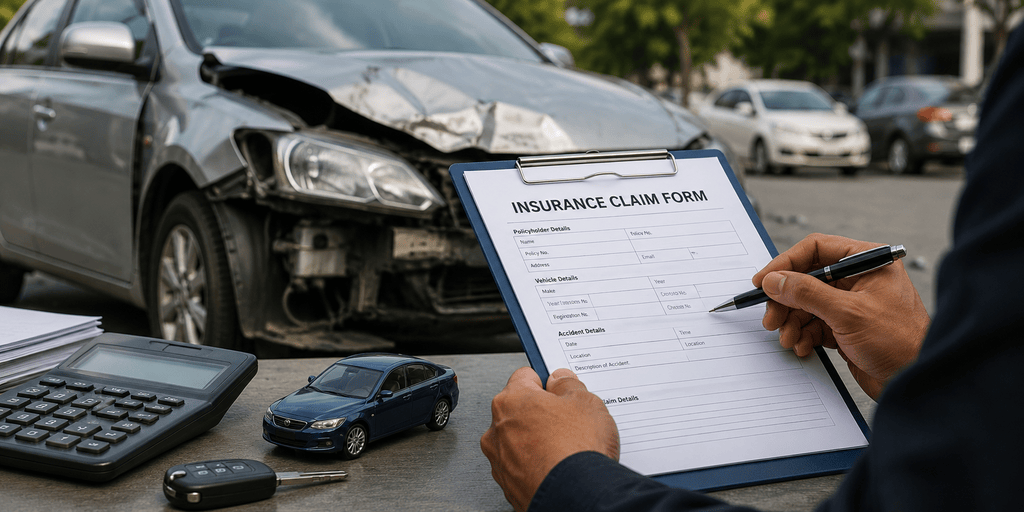
When a car is damaged badly enough, repairing it stops making financial sense, and your insurer moves the claim into an entirely different track. The settlement of a total loss car insurance claim in India does not work like a normal repair claim, and the math behind it, IDV minus salvage minus deductions, often surprises a lot of owners who expected something closer to their original purchase price. Understanding exactly how a total loss car insurance claim in India settlement is calculated, before you ever need one, is the best protection against accepting a figure that seems unreasonably low. This guide walks through exactly how these claims are decided, calculated, and settled, with a worked example to make the numbers concrete rather than abstract.
Total Loss vs Constructive Total Loss
These two terms get used almost interchangeably in everyday conversation, but they describe slightly different situations. Total loss, in the strict sense, means your car has been destroyed or is permanently incapable of use, or that it was stolen and never recovered. Constructive total loss car insurance applies to a different scenario: your car is technically repairable, but the cost of doing so is so high relative to its value that repairing it no longer makes economic sense.
Under the India Motor Tariff, which governs how Indian insurers classify these claims, a vehicle is declared a constructive total loss when the aggregate cost of repair or retrieval exceeds 75 per cent of its Insured Declared Value. Both total loss and CTL result in the same outcome for you as the policyholder: instead of a repair bill being settled, you receive a payout based on your car's IDV rather than actual repair costs.
How Insurers Decide a Vehicle Is a CTL
After you report an accident, the insurer assigns a licensed surveyor to inspect the vehicle and prepare a formal repair estimate. If that estimate, once totalled, crosses the 75 per cent threshold against your policy's IDV, the surveyor recommends the claim be treated as a constructive total loss rather than a standard repair claim. This decision is based on the surveyor's professional assessment and is documented in a formal report that becomes the basis for your settlement.
It is worth asking for a copy of this surveyor report, since it forms the technical justification for your payout and is the document you would need if you ever want to challenge the insurer's assessment. Insurers are required to base this decision on your policy's IDV, not a fresh market valuation, since the India Motor Tariff specifically treats IDV as the vehicle's agreed value throughout the policy period for total loss purposes, without any additional depreciation applied on top of it.
This distinction matters more than it might seem. Some policyholders assume the insurer can revalue their car downward at the time of a claim, applying fresh depreciation beyond what was already baked into the IDV at renewal. That is not how the rules work. Your IDV, once set at the start of your policy period, is the figure the entire total loss calculation is built around, which is exactly why setting an accurate IDV at renewal, rather than accepting an artificially low figure to save a small amount on premium, matters far more than most owners realise until they actually need to file this kind of claim.
Settlement Process and IDV-Based Payout
Here is exactly how the math works, using round numbers to make it concrete. Say your car's IDV, as stated in your policy, is 8 lakh rupees. After an accident, the surveyor estimates repair costs at 6.5 lakh rupees, which works out to just over 81 per cent of your IDV, comfortably past the 75 per cent CTL threshold. Your insurer declares the claim a constructive total loss.
At this point, the settlement calculation is: Net Claim equals IDV, minus the salvage value of the wreck, minus your compulsory deductible. If the wreck is independently valued at 80,000 rupees and your compulsory deductible is 2,000 rupees, your net payout works out to 8,00,000 minus 80,000 minus 2,000, which equals 7,18,000 rupees. For those wondering how is total loss claim settled in car insurance in practice, this math is the answer. The settlement is calculated not as a fraction of repair costs, but as your full IDV, reduced only by the wreck's value and your standard deductible.
Salvage Value Deduction Explained
Salvage value car insurance deductions exist because, in a total loss settlement, ownership of the damaged vehicle typically transfers to the insurer, who then sells the wreck, usually for scrap or spare parts. Since the insurer is effectively taking possession of something with residual value, that value is deducted from your payout rather than being handed to you on top of the full IDV.
You do have an alternative. Most insurers allow you to retain the wreck yourself instead of surrendering it, in which case the salvage value is still deducted from your payout in the same way, but you keep the vehicle, perhaps to sell its parts yourself or repair it privately outside the insurance process. This retention option is worth considering if you believe you can get more value from the wreck independently than the insurer's salvage valuation suggests, though you should get an independent opinion on the wreck's worth before agreeing to the insurer's figure, since salvage valuations are a common point of dispute.
Total Loss Claims When the Car Has an Active Loan
A total loss claim on car with active loan follows an important additional step. Since the lender holds a financial interest in the vehicle through hypothecation, the settlement amount is directed to the financier first, up to the outstanding loan balance, with any remainder paid to you afterwards.
This creates a real financial risk worth understanding clearly before it happens to you. If your outstanding loan balance is higher than your settlement payout, which can occur if your car has depreciated faster than your loan has been paid down, you remain personally liable for the difference. This gap tends to be largest in the early years of a loan, when the outstanding balance is still high, but the car's IDV has already started depreciating, which is exactly the situation where an add-on like return to invoice cover would have closed the gap had it been purchased at the time of buying the policy.
Total Loss Due to Theft vs Accident: What Changes
The core settlement math, IDV minus salvage minus deductible, stays the same whether your car was stolen or damaged beyond repair in an accident, but the path to reaching that settlement differs. For an accident-based total loss, a surveyor physically inspects the vehicle and prepares a repair estimate that triggers the CTL classification.
For theft, there is no vehicle to inspect, so the process instead requires you to file an FIR immediately and wait for the police to formally close their investigation with a Non-Traceable Certificate confirming the vehicle could not be recovered. Only once this certificate is issued does the insurer typically proceed with settling the claim as a total loss. This means theft claims usually take meaningfully longer to settle than accident-based CTL claims, since the timeline depends partly on police investigation speed rather than solely on your insurer's internal process.
Documents Required for a Total Loss Claim
A total loss claim documents required checklist typically includes your duly filled claim form, your original insurance policy, the vehicle's Registration Certificate, your driving licence, and clear photographs of the damage for accident-based claims. An original purchase invoice helps the insurer verify figures used in your IDV calculation, and a cancelled cheque is needed for the electronic transfer of your settlement amount.
For theft claims specifically, you will additionally need the FIR filed at the time of the theft and the Non-Traceable Certificate issued once police investigation concludes without recovering the vehicle. If your car had an active loan, expect your insurer to also coordinate directly with your financier as part of the documentation and payout process, so keeping your loan account details handy speeds this step along.
Typical Settlement Timeline
Once a surveyor's report confirms a constructive total loss and all required documents are submitted, settlement commonly takes around two to four weeks, though this varies by insurer, the complexity of your case, and how quickly you provide requested documents. Theft-based total loss claims generally take longer, since the timeline is anchored to when police issue the Non-Traceable Certificate, a step entirely outside your insurer's control.
Delays are more common when there is a dispute over the surveyor's repair estimate, the salvage valuation, or when a loan payoff needs to be coordinated with a financier. Responding promptly to any document requests from your insurer, and following up in writing rather than only by phone, tends to keep your specific claim moving without unnecessary gaps.
How to Dispute a Low Total Loss Settlement Offer
If your settlement offer looks significantly lower than expected, you do have the right to question it, and this is worth doing before you sign anything final. Start by requesting a copy of the surveyor's report and the specific salvage valuation used in your calculation, since disputes most commonly centre on an inflated salvage value or an incorrectly applied deduction rather than the IDV itself, which is fixed by your policy document.
If you believe the salvage valuation is unfair, an independent valuation from a separate assessor can support your case. Avoid signing a full and final discharge voucher under pressure before you are satisfied with the settlement, since accepting one typically closes off further negotiation on that specific claim. If your insurer remains unresponsive to a genuine dispute, escalating through IRDAI's Bima Bharosa portal and, if necessary, the Insurance Ombudsman gives you a structured, free path to a resolution beyond what your insurer initially offers.
FAQs
Q. How is total loss claim settled in car insurance if I disagree with the surveyor's estimate?
You can request the surveyor's report, seek an independent repair or valuation estimate, and raise a formal dispute with your insurer before accepting a final settlement figure.
Q. What happens to salvage in a total loss claim if I want to keep my car?
You can generally choose to retain the wreck instead of surrendering it to the insurer, though the salvage value is still deducted from your payout either way.
Q. Total loss claim on car with active loan: who gets paid first?
Your lender is paid first, up to the outstanding loan balance, from the settlement amount, with any remaining balance paid to you afterwards.
Q. What documents are needed for a total loss car insurance claim in India settlement?
Your claim form, policy document, RC, driving licence, damage photographs or FIR depending on the cause, and a cancelled cheque, with a Non-Traceable Certificate additionally required for theft claims.
Q. Does a total loss claim affect my No Claim Bonus?
Yes. Filing any claim, including a total loss claim, resets your accumulated No Claim Bonus to zero, since NCB rewards a completely claim-free renewal history.
Q. How long does a constructive total loss car insurance settlement typically take?
Around two to four weeks for accident-based claims once all documents are submitted, though theft claims usually take longer due to the police investigation timeline.
Q. Can the insurer pay me less than my policy's IDV in a total loss settlement?
Deductions for salvage value and your compulsory deductible are standard and expected, but the underlying IDV itself should not be further reduced through additional depreciation under total loss rules.
Q. Is there a difference in total loss settlement IDV calculation between theft and accident claims?
No. The settlement formula, IDV minus salvage minus deductible, is identical in both cases. What differs is the process and documentation required to reach that settlement.
Q. What if my car loan balance is higher than my total loss settlement?
You remain personally responsible for paying the difference to your lender, which is why add-ons like return to invoice cover are worth considering on a newer car with an active loan.
Q. Can I negotiate the salvage value car insurance deduction on my claim?
Yes. If you believe the insurer's salvage valuation is inflated, obtaining an independent valuation and raising a formal dispute is a reasonable and fairly common step before accepting a settlement.

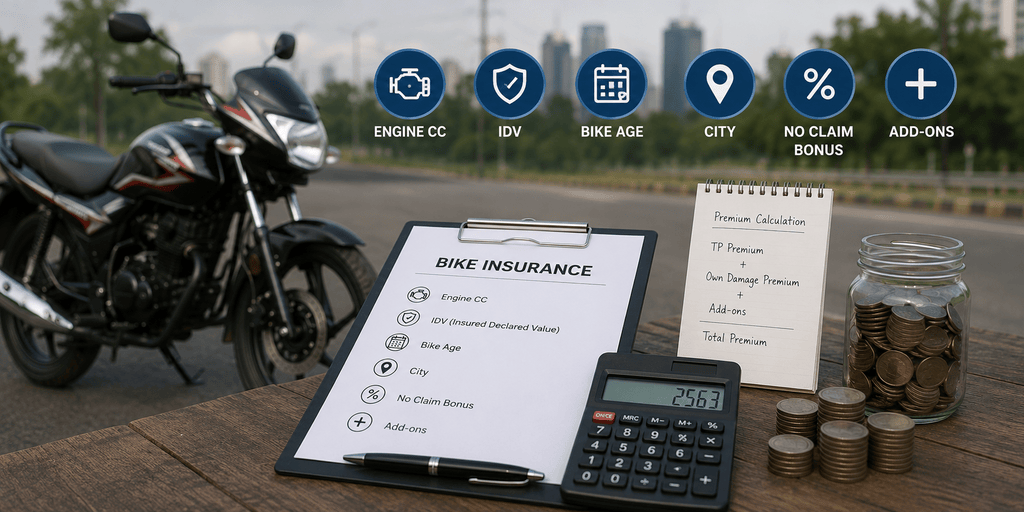
Two riders with what looks like the same bike can end up with noticeably different insurance quotes, and it is rarely a mistake on either side. Bike insurance premium calculation follows a defined set of rules, but those rules respond to more individual factors than most riders realise, from your city to your claim history to how you set your bike's declared value. This guide breaks down the factors affecting two wheeler insurance premium one by one, covering every major bike insurance cost factor, so a quote stops feeling arbitrary and starts feeling explainable.
Key Factors That Determine Bike Insurance Premium
Every comprehensive bike insurance premium is built from two separate pieces added together, and understanding this split is the foundation of any accurate bike insurance premium calculation. The first is third party premium, a flat rate fixed by IRDAI based purely on your bike's engine capacity, identical no matter which insurer you buy from. The second is own damage premium, which is where most of the variation between riders, and between insurers, actually shows up.
Own damage premium responds to your bike's Insured Declared Value, its age, your registration city, your claim history and accumulated No Claim Bonus, and any add-ons you choose to include. Two wheeler insurance premium in India can differ meaningfully between two riders with the same bike model simply because one lives in a higher theft city, has a longer claim-free streak, or has chosen a different set of add-ons.
How Engine CC Affects Your Premium
Engine capacity is the single factor that determines your fixed third party premium, and IRDAI groups two-wheelers into bands rather than pricing each cc individually. A 100cc commuter and a 145cc commuter typically land in the same third party band, while a 350cc or larger motorcycle moves into a meaningfully higher bracket. This portion of your premium cannot be reduced through negotiation or by switching insurers, since it is a fixed regulatory rate.
Engine capacity also has an indirect effect on own damage premium, since larger, more powerful bikes tend to have higher ex-showroom prices, which pushes up their Insured Declared Value and, with it, the own damage portion of your total premium. A bigger engine rarely changes your premium through cc alone beyond the fixed third party band, but it very often changes your premium through the higher IDV that tends to come attached to it.
How IDV Affects Your Premium
Insured Declared Value is the maximum amount your insurer pays if your bike is stolen or damaged beyond repair, and it directly drives your own damage premium. A higher IDV means a higher potential payout for the insurer, which translates into a higher premium. A lower IDV reduces your premium but also caps what you can actually claim.
This creates a genuine temptation to under-declare IDV to save a modest amount on premium, which is one of the more common and costly mistakes riders make. If your bike is later stolen or totalled, you are locked into whatever IDV you agreed to at the start of the policy period, so an artificially low figure directly reduces your payout exactly when you need it most. Setting IDV close to your bike's genuine current market value, rather than the lowest figure your insurer will accept, is almost always the better long-term choice.
How Bike Age and City Affect Premium
Your bike's age drives IDV down through a standard depreciation schedule, which in turn reduces own damage premium year after year, even before any No Claim Bonus is factored in. A five-year-old bike will generally carry a noticeably lower own damage premium than the same model when it was new, simply because its IDV has depreciated substantially over that period.
Registration city affects premium independently of age or engine size, since insurers price in local accident frequency and theft rates. Riders in dense metro areas with higher traffic volumes and higher reported theft generally see higher own damage premiums than riders with an identical bike registered in a smaller town with lighter traffic and a lower theft profile.
Third-Party Premium: IRDAI Fixed Rates by CC Slab
The table below reflects the general structure of IRDAI's notified third party rates for two-wheelers, current as of recent notifications. Since IRDAI reviews these periodically, confirm the exact current figures before relying on them for a purchase decision.
| Engine Capacity | Approximate Annual Third Party Premium |
|---|---|
| Up to 75cc | Rs 538 |
| 75cc to 150cc | Rs 714 |
| 150cc to 350cc | Rs 1,366 |
| Above 350cc | Rs 2,804 |
Since this portion of your premium is identical across every insurer, it is not worth spending time comparing on this component specifically. Where genuine comparison shopping pays off is entirely on the own damage side.
How Own Damage Premium Is Calculated
Own damage premium is generally calculated as a percentage of your bike's IDV, adjusted by insurer-specific rate factors tied to your bike model, city, and risk profile, then reduced by any No Claim Bonus you have accumulated. Different insurers apply somewhat different base rates to the same IDV, which is exactly why two comprehensive quotes for the same bike can differ even when the IDV figure itself is identical across both.
Add-ons are calculated separately and added on top of this base own damage premium, each priced according to the specific risk it covers. Zero depreciation cover, for instance, is priced higher than a smaller add-on like roadside assistance, since it increases the insurer's potential payout on every claim rather than covering a narrower, less frequent risk.
Sample Premium Table by Engine CC
To make this concrete, here is an illustrative first-year premium range across different engine capacity bands, using typical IDV assumptions for popular models in each band. These are indicative figures meant to show the general pattern, not exact live quotes, since actual premium depends on your specific bike, city, and add-ons.
| Engine Band | Example Bike Type | Indicative Total Comprehensive Premium (Year 1) |
|---|---|---|
| Up to 75cc | Basic scooter or moped | Rs 2,200 to 2,800 |
| 75cc to 125cc | Standard commuter bike or scooter | Rs 2,700 to 3,400 |
| 125cc to 150cc | Sporty commuter or entry naked bike | Rs 3,200 to 4,200 |
| 150cc to 350cc | Mid-size cruiser or tourer | Rs 5,500 to 7,500 |
| Above 350cc | Premium or high-capacity motorcycle | Rs 9,000 and above |
Notice how the jump between bands is driven far more by IDV than by the modest step-up in fixed third party premium, reinforcing that own damage cost is where the real variation in your total bill comes from.
Role of NCB in Reducing Premium
No Claim Bonus is one of the most significant levers you have over your own premium, applying only to the own damage portion and rising with each consecutive claim-free year. The standard progression runs from 20 per cent after one claim-free year to a maximum of 50 per cent after five consecutive years without a claim.
This is why riders wondering why is my bike insurance premium so high across renewal years sometimes overlook the simplest explanation: a single claim, even a small one, resets this discount entirely back to zero at the next renewal. Weighing whether a minor repair costs less than the NCB you would lose by claiming for it is worth doing every time, rather than filing every small claim reflexively.
How Add-ons Affect Total Premium
Add-ons increase your premium incrementally, and understanding roughly how much each one adds helps you choose deliberately rather than accepting a bundled package by default. Zero depreciation cover tends to be the costliest individual add-on, since it removes depreciation deductions on every claim. Engine protection, useful for riders in flood-prone cities, typically adds a moderate amount. Roadside assistance and NCB protection are usually the least expensive additions available.
Rather than accepting a pre-selected bundle, most insurers let you toggle add-ons individually, which is worth doing so you can see exactly how much each one costs relative to the protection it offers for how you actually ride.
Why Insurers Treat Cities Differently
City-based pricing often surprises riders more than any other factor on this list, since it feels less within your control than choices like IDV or add-ons. Insurers build their own damage rate factors partly from claims data specific to each city, tracking how often bikes registered there are stolen, how frequently accidents get reported, and how expensive repairs tend to run locally due to labour and parts costs.
This is why identical bikes with identical IDV can carry a genuinely different own damage premium purely based on the RTO code on the registration. If you are relocating and re-registering your bike, or simply curious why your renewal quote looks different from a friend's in another city, this city-level risk pricing is very often the answer, separate from anything about your personal riding history.
Ways to Reduce Your Bike Insurance Premium
A handful of practical choices can meaningfully lower your total premium without cutting essential coverage. Protecting your No Claim Bonus by avoiding claims for very minor damage is the single most effective lever available to most riders over time. Choosing a voluntary deductible, an amount you agree to pay out of pocket before your insurer contributes to a claim, reduces own damage premium in exchange for accepting more risk yourself.
Comparing quotes across two or three insurers before renewing matters more than people expect, since own damage rate factors genuinely differ between companies even for an identical bike and IDV. Fitting an approved anti-theft device can also unlock a modest discount from several insurers, and setting an accurate rather than inflated IDV keeps your premium proportionate to your bike's real value instead of paying for coverage you do not actually need.
FAQs
Q. How is bike insurance premium calculated in India exactly?
It combines a fixed third party rate set by IRDAI based on engine capacity with a variable own damage premium based on your bike's IDV, age, city, claim history, and chosen add-ons.
Q. Why is my bike insurance premium so high compared to last year?
Common reasons include a claim that reset your No Claim Bonus, a change in your bike's IDV, an insurer-wide rate revision, or newly added covers that were not part of your previous policy.
Q. What does bike insurance premium by engine cc 2026 look like for a 150cc bike?
Third party premium for a 150cc bike falls in the mid engine band, while total comprehensive premium including own damage typically runs into the low thousands of rupees annually, depending on IDV and add-ons.
Q. Does a higher IDV always mean better value?
Not necessarily. A higher IDV increases your maximum payout but also raises your premium, so the ideal figure closely reflects your bike's actual current market value rather than being pushed artificially high.
Q. Can I reduce my bike insurance premium without dropping coverage?
Yes, primarily by protecting your NCB, comparing quotes across insurers, considering a voluntary deductible, and fitting an approved anti-theft device where a discount is available.
Q. Do all insurers charge the same third party premium for the same bike?
Yes. The third party premium is fixed by IRDAI based on engine capacity and is identical across every insurer, so comparison shopping only affects the own damage portion of your premium.
Q. How much does No Claim Bonus actually save on renewal?
It can reduce your own damage premium by up to 50 per cent after five consecutive claim-free years, making it one of the largest single savings levers available to any rider.
Q. Does my bike's age reduce my premium automatically?
Yes, since IDV depreciates on a standard schedule as your bike ages, which reduces own damage premium correspondingly, separate from any NCB discount you may have also earned.
Q. Why do two riders with the same bike model pay different premiums?
Differences usually come from IDV, registration city, claim history, NCB status, and the specific add-ons each rider has chosen, rather than the bike model itself.
Q. Is it worth adding zero depreciation cover to a bike insurance premium calculation?
For newer or higher-value bikes, it is generally worth the added cost, since it meaningfully improves your payout on replaced parts during a claim, which matters most while your bike is newest and most expensive to repair.



Licenced by

COMPANY
PRODUCTS
RESOURCES
LEGAL
Cars24 Financial Services Private Limited
(Wholly owned subsidiary of Cars24 Services Private Limited)
Corporate Office - 6th Floor, SAS Tower-C, Ch Baktawar Singh Road, Medicity Sector 38, Shivaji Nagar,
Gurgaon - 122001, Haryana
IRDAI Corporate Agency Registration No: CA0710 | Registration Validity: Perpetual |
CIN: U65990HR2018PTC075713
Disclaimer : The information contained in this website is presented purely for information purposes only provided as service to the internet community at large. It does not constitute insurance advice and we do not guarantee the accuracy, adequacy or the completeness of the information contained here.


Licenced by
COMPANY
PRODUCTS
RESOURCES
LEGAL
Cars24 Financial Services Private Limited
(Wholly owned subsidiary of Cars24 Services Private Limited)
Corporate Office - 6th Floor, SAS Tower-C, Ch Baktawar Singh Road, Medicity Sector 38, Shivaji Nagar,
Gurgaon - 122001, Haryana
IRDAI Corporate Agency Registration No: CA0710
Registration Validity: Perpetual
CIN: U65990HR2018PTC075713
Disclaimer : The information contained in this website is presented purely for information purposes only provided as service to the internet community at large. It does not constitute insurance advice and we do not guarantee the accuracy, adequacy or the completeness of the information contained here.