


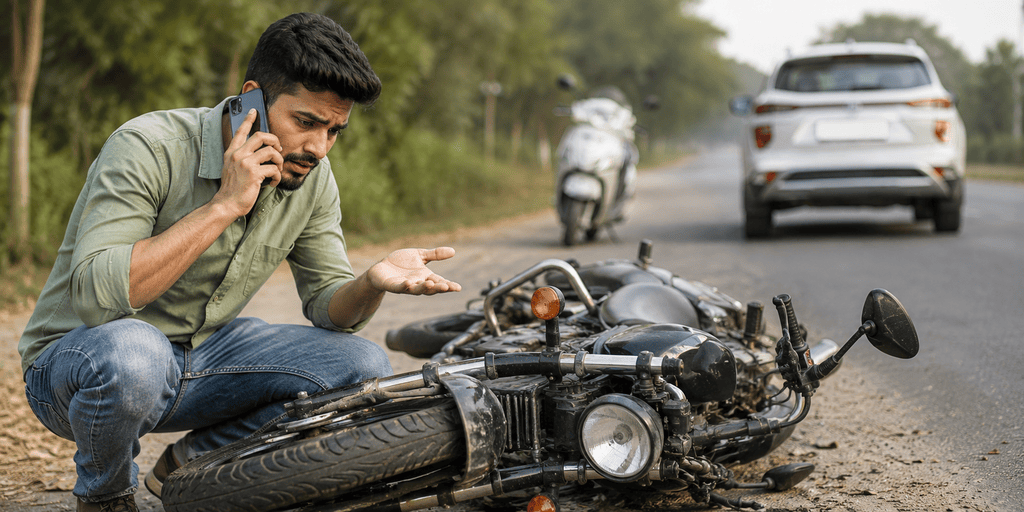
Here's a scenario that plays out often enough to be worth walking through. A rider's 110cc gearless scooter goes missing from a parking lot on a Monday evening. The FIR doesn't get filed until Thursday, four days later. The insurer rejects the theft claim, citing delayed intimation and a failure to file the FIR within the window set out in the policy's theft clause. The rider had assumed "insurance covers theft" and never read the fine print requiring prompt police reporting.
Most articles about two-wheeler claim rejections list generic reasons and stop there. They don't explain what the rejection letter actually says, what the rider did wrong in practical terms, or what to do next. This one covers both. It walks through the rejection triggers that are specific to two-wheelers, and the operational steps of appealing through the insurer's grievance cell, the IRDAI's complaint portal, and the Insurance Ombudsman.
Two-Wheeler-Specific Rejection Triggers That Car Insurance Articles Miss
A bike insurance claim can be rejected for reasons that simply don't apply to cars. Most articles on this topic repurpose generic motor insurance rejection reasons, an expired policy, drink driving, undisclosed modifications, without isolating what actually trips up scooter and motorcycle riders. Three triggers stand out.
Driving Licence Class Mismatch: Gearless vs. Geared Bikes
A licence to ride a motorcycle without gear (MCWOG) doesn't authorise riding a motorcycle with gear (MCWG). These are separate licence classes under India's motor vehicle licensing rules. They're not interchangeable in one direction: an MCWOG licence never covers a geared bike, though an MCWG licence typically covers gearless ones too. A rider holding only an MCWOG licence who rides a 150cc geared motorcycle and files an accident claim can face rejection for "invalid driving licence at the time of incident."
The classes break down like this:
- MCWOG: scooters and gearless bikes.
- MCWG: motorcycles with a manual gearbox, regardless of engine size.
- LMV: light motor vehicles like cars, not relevant to two-wheeler claims.
Here's what most riders overlook: this isn't about engine size alone. A 125cc geared motorcycle requires an MCWG licence. A 160cc gearless scooter requires only MCWOG. What the insurer checks is the licence class printed on the card against the Registration Certificate's vehicle classification, not the cc figure a rider might assume matters more.
Theft Claims Below the FIR Threshold: When a Police Complaint Isn't Enough
For theft claims, most insurers require a First Information Report (FIR), a formal police document that initiates a criminal investigation. A General Diary (GD) entry isn't the same thing. A GD entry records that someone visited the station and reported something, but it doesn't trigger an investigation.
That distinction changes the timeline in practice. Police stations sometimes resist filing FIRs for two-wheeler theft, particularly for older or lower-value bikes. Officers may suggest a GD entry instead, with an informal "come back if the bike isn't found." A rider who accepts that as sufficient often finds the insurer rejecting the claim afterward for insufficient documentation, because a GD entry alone typically isn't what the policy requires.
Pillion Rider Injury Claims: The Exclusion Most Riders Don't Know Exists
Third-party liability cover, mandatory under the Motor Vehicles Act, 1988, covers injury to a third party caused by the insured vehicle. But the own-damage section of a comprehensive policy doesn't cover the policyholder's own medical expenses or a pillion rider's medical expenses. That falls under personal accident cover, which is compulsory for the owner-driver, at a minimum sum insured of ₹15 lakh under IRDAI's September 2018 circular, and optional for pillion passengers.
Most people assume "comprehensive" means everything is covered. It covers damage to the bike and third-party liability, but not medical bills for the rider or pillion unless separate personal accident cover is in place. A claim for pillion injury treatment filed under the own-damage section typically gets rejected, with the rejection letter stating that medical expenses aren't payable under that section of the policy.
Policy Lapse and Break-In Inspection: What Actually Happens When Bike Insurance Expires Before a Claim
A claim filed during a lapsed policy period is void, with no exceptions. No insurer honours it, and no Ombudsman overturns it. The policy has to be active, premium paid, cover in force, at the exact time of the incident.
The "grace period" myth is worth addressing directly. There's no statutory grace period for motor insurance renewal in India. Some insurers allow renewal within a window after expiry, commonly cited as up to 90 days, without requiring a break-in inspection, but this is insurer-specific practice, not a legal entitlement. Riders who assume they have a grace period and ride uninsured for weeks are fully exposed.
Once a policy has lapsed beyond an insurer's renewal window, a break-in inspection is required before a new policy can be issued. This is typically handled either through a physical inspection by the insurer's surveyor, or increasingly through photos or a short video submitted via the insurer's app. Which method applies depends on the insurer and the bike's value. The inspection checks for existing damage and confirms the bike's condition before cover resumes; any pre-existing damage found is usually excluded from the new policy.
The No Claim Bonus (NCB) impact is worth checking too. NCB accumulates year-on-year and resets to zero if the policy lapses beyond the renewal window. IRDAI's standard NCB slabs are 20%, 25%, 35%, 45%, and 50% for claim-free years one through five. For a two-wheeler with five years of NCB at the maximum slab, a lapse of just a few weeks can mean a meaningful jump in the renewal premium.
Documentation Errors That Trigger Rejection
The surveyor's report is the single most influential document in a claim decision. For two-wheelers, the surveyor is often a third-party professional appointed by the insurer, not an in-house employee. Their report determines whether the reported damage is consistent with the claimed incident, and whether the paperwork matches the bike in front of them.
Common documentation failures specific to two-wheelers:
RC not transferred after buying a used bike. The policyholder's name doesn't match the RC owner's name. Form 29 (notice of transfer of ownership) and Form 30 (report of transfer) should have been filed at the RTO at the time of purchase; many used-bike buyers skip this. It's worth noting that the law in this area isn't fully settled: under Section 157 of the Motor Vehicles Act, insurance is deemed to transfer along with the vehicle's ownership, and the new owner has 14 days to formally notify the insurer. Whether that deemed transfer covers own-damage claims the same way it covers third-party liability has been treated inconsistently across court rulings, and the question has been referred to a larger Supreme Court bench. In practice, insurers often still reject own-damage claims where the RC hasn't been formally transferred, so treating the transfer as something to complete promptly, rather than relying on the deemed-transfer provision, is the safer approach.
Engine number mismatch after a non-disclosed engine replacement. If a rider swaps the engine and doesn't update the RC or inform the insurer, the surveyor catches the discrepancy between the engine number on the policy schedule and the number stamped on the block.
Chassis number plate problems on older bikes. Corrosion or damage to the chassis number plate on bikes over 10 to 12 years old can make verification difficult. A surveyor's note of "chassis number illegible" can stall processing or give the insurer grounds to question the bike's identity.
The timestamp problem is also real. Many two-wheeler accidents happen on roads without CCTV coverage. Without corroborating evidence, a surveyor may note "cause of damage unverifiable," which gives the insurer grounds to reject or reduce a claim. Taking photos at the scene right after an incident helps. Many smartphones can embed GPS coordinates and timestamps in photo metadata automatically, though this depends on location services being enabled. Some messaging apps also strip that metadata when photos are shared, so keeping an unedited original is worth doing.
Modified Bikes and Aftermarket Parts: Where the Policy Wording Draws the Line
Standard comprehensive policies cover the bike as described in the policy schedule. Modifications not disclosed to the insurer at the time of policy issuance or renewal are typically not covered and can void the claim entirely.
There's a distinction that matters here. Cosmetic accessories, alloy wheels, seat covers, phone mounts, are coverable under electrical or non-electrical accessories if declared and an additional premium is paid. Structural modifications that change the bike's performance or safety profile are a different matter entirely.
Two-wheeler modifications that commonly trigger rejection:
Aftermarket exhaust systems. A non-homologated aftermarket exhaust changes emission compliance and is visible to any surveyor on first glance.
Engine bore-up kits that increase displacement beyond what the RC states. A 150cc bike bored to 180cc no longer matches the policy schedule or the RC, and that mismatch is typically fatal to the claim.
- Structural handlebar or chassis modifications: café racer conversions, raised handlebars, swingarm extensions.
If a modification is disclosed at policy issuance and the insurer accepts it, typically with an adjusted IDV and premium, it's covered. The problem is almost always non-disclosure, not the modification itself.
The FIR and Delayed Intimation Problem
Most policies require prompt intimation of an incident to the insurer. The exact window is set by individual policy wording rather than a single legal standard, and riders often delay without realising it matters. They're injured. The bike is in a remote area. They don't immediately realise the damage qualifies for a claim.
Here's a common pattern: a rider skids on a wet road, picks up the bike, rides home, and only assesses the damage the next morning. The insurer is called on day two. Whether that counts as "delayed intimation" depends on the specific insurer and policy wording. It's worth checking your own policy's stated intimation window rather than assuming a standard number of hours applies universally.
FIR requirements vary by claim type:
Theft: an FIR is required in virtually all cases, a GD entry won't be accepted.
Accident involving a third party: an FIR is typically required.
- Own-damage (a single-vehicle fall or pothole damage): an FIR may or may not be required, depending on the insurer. Riders who skip filing one for a pothole fall sometimes face rejection later for exactly this reason.
Expired or Wrong-Class Driving Licence: The Rejection Trigger With a Notable Overturn Rate at the Ombudsman
An expired licence at the time of an accident is one of the most common rejection reasons for bike insurance claims, but not every expired-licence rejection holds up on appeal. Insurance Ombudsman and Consumer Commission rulings have generally drawn a line between two situations:
A licence expired by a few days, where the rider held the correct class and simply hadn't renewed. Some rulings have treated this as a procedural lapse rather than a fundamental invalidity.
- A licence of the wrong class entirely (MCWOG held by someone riding an MCWG bike). This is a substantive invalidity and is rarely overturned.
There's no guarantee an expired-licence rejection will be overturned on appeal; each case is assessed on its own facts.
To verify licence status before filing a claim, the Parivahan portal (Sarathi, at sarathi.parivahan.gov.in) allows online driving licence status verification. Entering the licence number and date of birth brings up the licence holder's name, licence class codes, validity dates, and current status, active, expired, or suspended.
How to Appeal a Rejected Bike Insurance Claim
A rejected claim isn't the end of the road. Four escalation stages exist, each with its own process, timeline, and realistic outcome.
Step 1: Internal Grievance Escalation With the Insurer
Every insurer is required by IRDAI to have a Grievance Redressal Officer (GRO). The first step after a rejection letter is filing a written complaint, by email and registered post, to the insurer's GRO.
The complaint should include:
- The rejection letter's reference number.
- Policy number and claim number.
- The specific grounds for disputing the rejection, citing the policy clause the rider believes was misapplied.
- Supporting documents: photos, the FIR copy, licence copy, RC, and any prior correspondence with the insurer.
Under IRDAI's Protection of Policyholders' Interests Regulations, the insurer must respond within 15 days of receiving the complaint.
Step 2: Escalating to IRDAI's Bima Bharosa Portal
If the insurer doesn't resolve the complaint within 15 days, or the response is unsatisfactory, the next step is IRDAI's online complaint portal. It's now known as Bima Bharosa, at bimabharosa.irdai.gov.in; the platform was previously called IGMS, the Integrated Grievance Management System, before being rebranded under this name.
One thing gets misunderstood constantly: Bima Bharosa is a complaint-forwarding and monitoring mechanism, not a binding adjudication body. IRDAI forwards the complaint to the insurer, which must respond, but IRDAI doesn't directly order the insurer to pay a claim.
Step 3: Insurance Ombudsman
If the portal escalation doesn't resolve the issue, the policyholder can approach the Insurance Ombudsman. The complaint generally needs to be filed within one year of the insurer's final rejection. The claim value must also fall within the Ombudsman's monetary jurisdiction, currently up to ₹50 lakh.
Under the Insurance Ombudsman Rules, the Ombudsman is expected to pass an award within three months of receiving all required documents from the complainant. If the award favours the policyholder, the insurer then has 30 days from receiving the award to comply. That 30-day window is a separate, later deadline from the Ombudsman's own three-month timeline for reaching a decision.
The Ombudsman's award is binding on the insurer once accepted by the complainant. The complainant retains the right to approach a consumer forum if unsatisfied with the outcome.
Step 4: Consumer Disputes Redressal Commission
If the Ombudsman route doesn't yield a satisfactory outcome, the policyholder can file with the District, State, or National Consumer Disputes Redressal Commission under the Consumer Protection Act, 2019. This is a judicial process and may require legal representation; consulting a legal professional before filing is advisable.
What to Do Immediately After a Bike Accident to Protect a Future Claim
The first 24 hours matter more than a generic checklist suggests. A timed sequence helps.
Within 1 hour:
- Call the insurer's helpline, printed on the policy document and available in the insurer's app.
- Take photos of the bike and the accident scene: damage to the bike, the road surface, debris, the surrounding area. If location services are enabled, many smartphones will embed GPS coordinates and timestamps into the photo metadata, which is useful to preserve in an unedited copy.
- Note the exact location.
Within 24 hours:
- File an FIR or GD entry as applicable, and get the police acknowledgement receipt with the FIR or GD number. Keep the original.
- Avoid moving the bike from the scene before documenting it, if it's safe to do so.
Within 48 to 72 hours:
- Submit online claim intimation through the insurer's portal or app, with photos and documents uploaded.
The single most common and costly mistake is getting the bike repaired before the surveyor inspects it. Riders routinely take a damaged bike to a local mechanic right after an accident: the mechanic fixes the bent handlebar, replaces the cracked fairing. By the time a surveyor arrives, or the rider files the claim days later, the damage has already been repaired and the insurer has no way to independently assess it. The claim is then rejected on exactly that basis. Don't authorise repair work until the insurer's surveyor has inspected the bike, or until the insurer has explicitly waived the survey requirement.
FAQs
Q. Can a bike insurance claim be rejected if the driving licence is expired by just a few days?
Yes, insurers may reject the claim. Policy wording typically requires a valid driving licence at the time of the incident. That said, some Ombudsman and Consumer Commission rulings have distinguished between a briefly expired licence, where the rider held the correct class and simply hadn't renewed, and a fundamentally invalid one. There's no guarantee of overturn on appeal; each case is assessed on its facts.
Q. What is the difference between an FIR and a GD entry for a bike theft insurance claim?
An FIR (First Information Report) is a formal police document that initiates a criminal investigation. A GD (General Diary) entry is a station-house record of a complaint that doesn't trigger an investigation. Most insurers require an FIR, not a GD entry, for theft claims; a GD entry alone can lead to rejection for insufficient documentation.
Q. Can a rejected two-wheeler insurance claim be appealed with IRDAI?
IRDAI doesn't directly adjudicate individual claims. Complaints can be filed via the Bima Bharosa portal, which forwards them to the insurer for a response. If the complaint remains unresolved, the Insurance Ombudsman can be approached next, and the Ombudsman's award is binding on the insurer once the complainant accepts it.
Q. How long does the Insurance Ombudsman take to resolve a bike insurance complaint?
Under the Insurance Ombudsman Rules, the Ombudsman is expected to pass an award within three months of receiving all required documents. If the award favours the policyholder, the insurer separately has 30 days after receiving that award to comply with it. That 30-day figure is the insurer's compliance deadline, not the Ombudsman's own decision timeline.
Q. Will a bike insurance claim be rejected for aftermarket modifications?
Modifications not disclosed to the insurer at policy issuance may void coverage for damage related to or caused by the modification. Cosmetic accessories that are declared and covered, with an additional premium paid, are treated separately. Each insurer's policy wording governs what counts as a covered accessory versus a structural modification.
Q. What happens if the bike is repaired before the insurance surveyor inspects it?
Pre-survey repairs are one of the most common grounds for two-wheeler claim rejection. The insurer's surveyor is generally expected to assess the damage before repair work begins, unless the insurer has explicitly waived the survey requirement.
Q. Is bike insurance valid if the RC is in someone else's name?
This is more nuanced than it first appears. Under Section 157 of the Motor Vehicles Act, insurance is legally deemed to transfer along with the vehicle when it's sold. The new owner then has 14 days to formally notify the insurer of the change. Courts have not been fully consistent on whether that deemed transfer extends to own-damage claims in the same way it does to third-party liability. In practice, insurers frequently still reject own-damage claims where the RC and policy haven't been formally updated. Completing Form 29 and Form 30 at the RTO promptly after a purchase is the safer path, rather than relying on the deemed-transfer provision.
Q. Can a consumer forum complaint be filed if a bike insurance claim is rejected?
Yes. After exhausting the insurer's internal grievance mechanism and, optionally, the Insurance Ombudsman, the policyholder can approach the District Consumer Disputes Redressal Commission under the Consumer Protection Act, 2019. This is a judicial process, so consulting a legal professional before filing is advisable.
Q. What documents are needed to appeal a rejected bike insurance claim?
The rejection letter, original claim documents (FIR or GD entry, photographs, repair estimate, RC, driving licence, policy copy), and written grounds for disputing the rejection. Add any supporting evidence you have, such as CCTV footage, witness statements, or medical reports where applicable.
Q. Does delayed intimation always lead to bike insurance claim rejection?
Not always. Insurers generally assess whether a delay was reasonable given the circumstances, for instance, if the rider was hospitalised and unable to communicate. The burden is on the policyholder to explain the delay with supporting evidence, and a delay of a few hours is treated very differently from a delay of several weeks.

Two riders with what looks like the same bike can end up with noticeably different insurance quotes, and it is rarely a mistake on either side. Bike insurance premium calculation follows a defined set of rules, but those rules respond to more individual factors than most riders realise, from your city to your claim history to how you set your bike's declared value. This guide breaks down the factors affecting two wheeler insurance premium one by one, covering every major bike insurance cost factor, so a quote stops feeling arbitrary and starts feeling explainable.
Key Factors That Determine Bike Insurance Premium
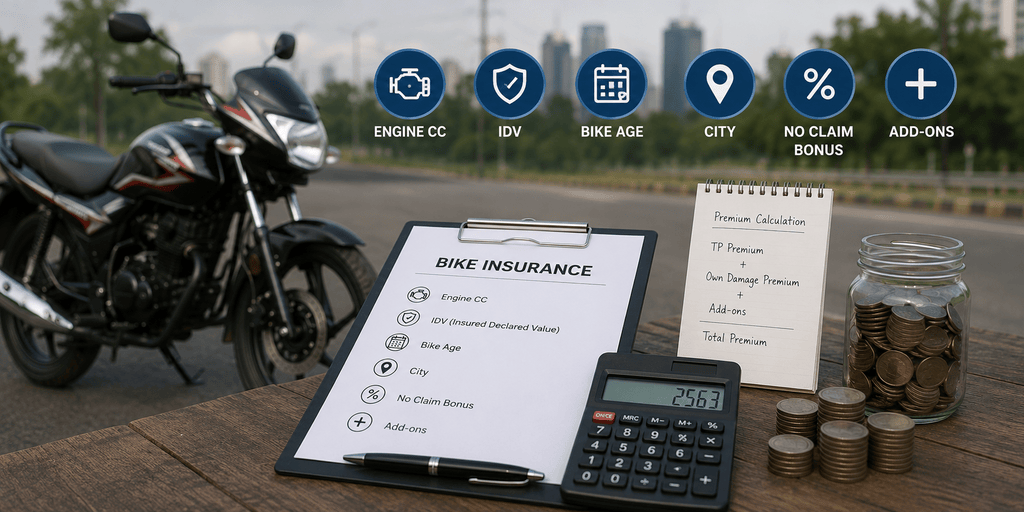
Every comprehensive bike insurance premium is built from two separate pieces added together, and understanding this split is the foundation of any accurate bike insurance premium calculation. The first is third party premium, a flat rate fixed by IRDAI based purely on your bike's engine capacity, identical no matter which insurer you buy from. The second is own damage premium, which is where most of the variation between riders, and between insurers, actually shows up.
Own damage premium responds to your bike's Insured Declared Value, its age, your registration city, your claim history and accumulated No Claim Bonus, and any add-ons you choose to include. Two wheeler insurance premium in India can differ meaningfully between two riders with the same bike model simply because one lives in a higher theft city, has a longer claim-free streak, or has chosen a different set of add-ons.
How Engine CC Affects Your Premium
Engine capacity is the single factor that determines your fixed third party premium, and IRDAI groups two-wheelers into bands rather than pricing each cc individually. A 100cc commuter and a 145cc commuter typically land in the same third party band, while a 350cc or larger motorcycle moves into a meaningfully higher bracket. This portion of your premium cannot be reduced through negotiation or by switching insurers, since it is a fixed regulatory rate.
Engine capacity also has an indirect effect on own damage premium, since larger, more powerful bikes tend to have higher ex-showroom prices, which pushes up their Insured Declared Value and, with it, the own damage portion of your total premium. A bigger engine rarely changes your premium through cc alone beyond the fixed third party band, but it very often changes your premium through the higher IDV that tends to come attached to it.
How IDV Affects Your Premium
Insured Declared Value is the maximum amount your insurer pays if your bike is stolen or damaged beyond repair, and it directly drives your own damage premium. A higher IDV means a higher potential payout for the insurer, which translates into a higher premium. A lower IDV reduces your premium but also caps what you can actually claim.
This creates a genuine temptation to under-declare IDV to save a modest amount on premium, which is one of the more common and costly mistakes riders make. If your bike is later stolen or totalled, you are locked into whatever IDV you agreed to at the start of the policy period, so an artificially low figure directly reduces your payout exactly when you need it most. Setting IDV close to your bike's genuine current market value, rather than the lowest figure your insurer will accept, is almost always the better long-term choice.
How Bike Age and City Affect Premium
Your bike's age drives IDV down through a standard depreciation schedule, which in turn reduces own damage premium year after year, even before any No Claim Bonus is factored in. A five-year-old bike will generally carry a noticeably lower own damage premium than the same model when it was new, simply because its IDV has depreciated substantially over that period.
Registration city affects premium independently of age or engine size, since insurers price in local accident frequency and theft rates. Riders in dense metro areas with higher traffic volumes and higher reported theft generally see higher own damage premiums than riders with an identical bike registered in a smaller town with lighter traffic and a lower theft profile.
Third-Party Premium: IRDAI Fixed Rates by CC Slab
The table below reflects the general structure of IRDAI's notified third party rates for two-wheelers, current as of recent notifications. Since IRDAI reviews these periodically, confirm the exact current figures before relying on them for a purchase decision.
| Engine Capacity | Approximate Annual Third Party Premium |
|---|---|
| Up to 75cc | Rs 538 |
| 75cc to 150cc | Rs 714 |
| 150cc to 350cc | Rs 1,366 |
| Above 350cc | Rs 2,804 |
Since this portion of your premium is identical across every insurer, it is not worth spending time comparing on this component specifically. Where genuine comparison shopping pays off is entirely on the own damage side.
How Own Damage Premium Is Calculated
Own damage premium is generally calculated as a percentage of your bike's IDV, adjusted by insurer-specific rate factors tied to your bike model, city, and risk profile, then reduced by any No Claim Bonus you have accumulated. Different insurers apply somewhat different base rates to the same IDV, which is exactly why two comprehensive quotes for the same bike can differ even when the IDV figure itself is identical across both.
Add-ons are calculated separately and added on top of this base own damage premium, each priced according to the specific risk it covers. Zero depreciation cover, for instance, is priced higher than a smaller add-on like roadside assistance, since it increases the insurer's potential payout on every claim rather than covering a narrower, less frequent risk.
Sample Premium Table by Engine CC
To make this concrete, here is an illustrative first-year premium range across different engine capacity bands, using typical IDV assumptions for popular models in each band. These are indicative figures meant to show the general pattern, not exact live quotes, since actual premium depends on your specific bike, city, and add-ons.
| Engine Band | Example Bike Type | Indicative Total Comprehensive Premium (Year 1) |
|---|---|---|
| Up to 75cc | Basic scooter or moped | Rs 2,200 to 2,800 |
| 75cc to 125cc | Standard commuter bike or scooter | Rs 2,700 to 3,400 |
| 125cc to 150cc | Sporty commuter or entry naked bike | Rs 3,200 to 4,200 |
| 150cc to 350cc | Mid-size cruiser or tourer | Rs 5,500 to 7,500 |
| Above 350cc | Premium or high-capacity motorcycle | Rs 9,000 and above |
Notice how the jump between bands is driven far more by IDV than by the modest step-up in fixed third party premium, reinforcing that own damage cost is where the real variation in your total bill comes from.
Role of NCB in Reducing Premium
No Claim Bonus is one of the most significant levers you have over your own premium, applying only to the own damage portion and rising with each consecutive claim-free year. The standard progression runs from 20 per cent after one claim-free year to a maximum of 50 per cent after five consecutive years without a claim.
This is why riders wondering why is my bike insurance premium so high across renewal years sometimes overlook the simplest explanation: a single claim, even a small one, resets this discount entirely back to zero at the next renewal. Weighing whether a minor repair costs less than the NCB you would lose by claiming for it is worth doing every time, rather than filing every small claim reflexively.
How Add-ons Affect Total Premium
Add-ons increase your premium incrementally, and understanding roughly how much each one adds helps you choose deliberately rather than accepting a bundled package by default. Zero depreciation cover tends to be the costliest individual add-on, since it removes depreciation deductions on every claim. Engine protection, useful for riders in flood-prone cities, typically adds a moderate amount. Roadside assistance and NCB protection are usually the least expensive additions available.
Rather than accepting a pre-selected bundle, most insurers let you toggle add-ons individually, which is worth doing so you can see exactly how much each one costs relative to the protection it offers for how you actually ride.
Why Insurers Treat Cities Differently
City-based pricing often surprises riders more than any other factor on this list, since it feels less within your control than choices like IDV or add-ons. Insurers build their own damage rate factors partly from claims data specific to each city, tracking how often bikes registered there are stolen, how frequently accidents get reported, and how expensive repairs tend to run locally due to labour and parts costs.
This is why identical bikes with identical IDV can carry a genuinely different own damage premium purely based on the RTO code on the registration. If you are relocating and re-registering your bike, or simply curious why your renewal quote looks different from a friend's in another city, this city-level risk pricing is very often the answer, separate from anything about your personal riding history.
Ways to Reduce Your Bike Insurance Premium
A handful of practical choices can meaningfully lower your total premium without cutting essential coverage. Protecting your No Claim Bonus by avoiding claims for very minor damage is the single most effective lever available to most riders over time. Choosing a voluntary deductible, an amount you agree to pay out of pocket before your insurer contributes to a claim, reduces own damage premium in exchange for accepting more risk yourself.
Comparing quotes across two or three insurers before renewing matters more than people expect, since own damage rate factors genuinely differ between companies even for an identical bike and IDV. Fitting an approved anti-theft device can also unlock a modest discount from several insurers, and setting an accurate rather than inflated IDV keeps your premium proportionate to your bike's real value instead of paying for coverage you do not actually need.
FAQs
Q. How is bike insurance premium calculated in India exactly?
It combines a fixed third party rate set by IRDAI based on engine capacity with a variable own damage premium based on your bike's IDV, age, city, claim history, and chosen add-ons.
Q. Why is my bike insurance premium so high compared to last year?
Common reasons include a claim that reset your No Claim Bonus, a change in your bike's IDV, an insurer-wide rate revision, or newly added covers that were not part of your previous policy.
Q. What does bike insurance premium by engine cc 2026 look like for a 150cc bike?
Third party premium for a 150cc bike falls in the mid engine band, while total comprehensive premium including own damage typically runs into the low thousands of rupees annually, depending on IDV and add-ons.
Q. Does a higher IDV always mean better value?
Not necessarily. A higher IDV increases your maximum payout but also raises your premium, so the ideal figure closely reflects your bike's actual current market value rather than being pushed artificially high.
Q. Can I reduce my bike insurance premium without dropping coverage?
Yes, primarily by protecting your NCB, comparing quotes across insurers, considering a voluntary deductible, and fitting an approved anti-theft device where a discount is available.
Q. Do all insurers charge the same third party premium for the same bike?
Yes. The third party premium is fixed by IRDAI based on engine capacity and is identical across every insurer, so comparison shopping only affects the own damage portion of your premium.
Q. How much does No Claim Bonus actually save on renewal?
It can reduce your own damage premium by up to 50 per cent after five consecutive claim-free years, making it one of the largest single savings levers available to any rider.
Q. Does my bike's age reduce my premium automatically?
Yes, since IDV depreciates on a standard schedule as your bike ages, which reduces own damage premium correspondingly, separate from any NCB discount you may have also earned.
Q. Why do two riders with the same bike model pay different premiums?
Differences usually come from IDV, registration city, claim history, NCB status, and the specific add-ons each rider has chosen, rather than the bike model itself.
Q. Is it worth adding zero depreciation cover to a bike insurance premium calculation?
For newer or higher-value bikes, it is generally worth the added cost, since it meaningfully improves your payout on replaced parts during a claim, which matters most while your bike is newest and most expensive to repair.


Licenced by

COMPANY
PRODUCTS
RESOURCES
LEGAL
Cars24 Financial Services Private Limited
(Wholly owned subsidiary of Cars24 Services Private Limited)
Corporate Office - 6th Floor, SAS Tower-C, Ch Baktawar Singh Road, Medicity Sector 38, Shivaji Nagar,
Gurgaon - 122001, Haryana
IRDAI Corporate Agency Registration No: CA0710 | Registration Validity: Perpetual |
CIN: U65990HR2018PTC075713
Disclaimer : The information contained in this website is presented purely for information purposes only provided as service to the internet community at large. It does not constitute insurance advice and we do not guarantee the accuracy, adequacy or the completeness of the information contained here.


Licenced by
COMPANY
PRODUCTS
RESOURCES
LEGAL
Cars24 Financial Services Private Limited
(Wholly owned subsidiary of Cars24 Services Private Limited)
Corporate Office - 6th Floor, SAS Tower-C, Ch Baktawar Singh Road, Medicity Sector 38, Shivaji Nagar,
Gurgaon - 122001, Haryana
IRDAI Corporate Agency Registration No: CA0710
Registration Validity: Perpetual
CIN: U65990HR2018PTC075713
Disclaimer : The information contained in this website is presented purely for information purposes only provided as service to the internet community at large. It does not constitute insurance advice and we do not guarantee the accuracy, adequacy or the completeness of the information contained here.