


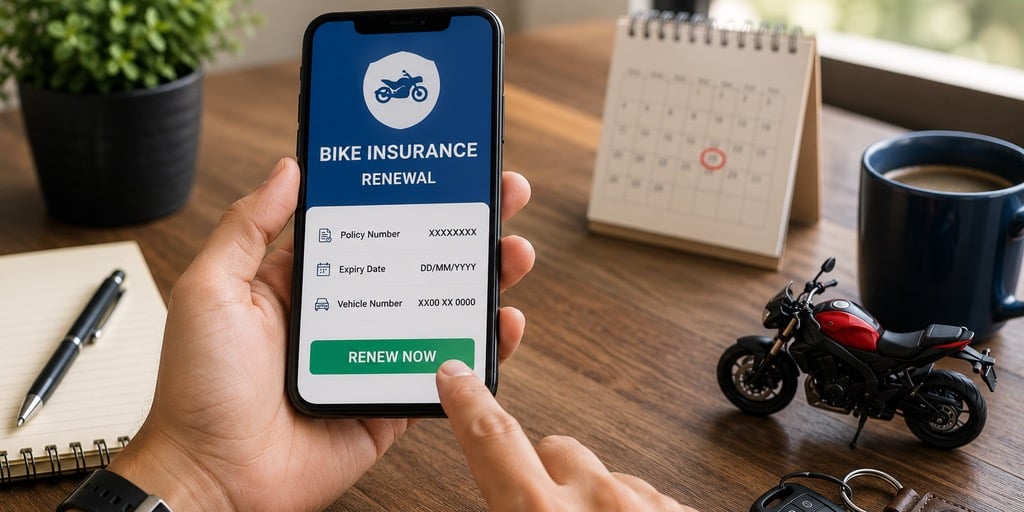
Renewing your bike insurance cover is one of those small tasks that is easy to do and expensive to forget. Miss the date, and you risk riding illegally, losing your hard-earned no-claim bonus, and being exposed to repair bills you would otherwise never pay. The good news is that bike insurance renewal online now takes minutes from your phone, and doing it on time ensures complete financial protection. This ultimate guide walks you through everything you need to know about online bike insurance renewal, including exactly when to renew, what happens if you let the policy lapse, and how to complete your two wheeler insurance renewal online without a single trip to an insurer’s office.
When to Renew Your Bike Insurance
When it comes to two wheeler insurance renewals, the simplest rule is to renew before your current policy expires. Most insurers open the renewal window 30 to 45 days before the expiry date, so there is no need to wait until the last day. Renewing early carries no penalty and removes the risk of a forgotten date leaving you uninsured.
Set a reminder a month ahead and treat the renewal as a quick annual check rather than a tedious task. Early bike insurance renewal keeps your cover continuous, protects your No-Claim Bonus, and gives you time to compare insurers calmly instead of buying in a rush. If you have a long-term third-party policy bought with a new bike, remember that the own-damage portion may still need annual renewal, so check both parts and ensure to renew the one expiring.
What Happens When a two wheeler Insurance Lapses
A lapsed policy is not a small problem. The moment your cover expires, several things change at once, and none of them works in your favour.
- As soon as you miss your renewal, your bike becomes uninsured, and riding it on a public road is then considered illegal under the Motor Vehicles Act.
- A first offence in such a situation can attract a fine of 2,000 rupees, and a repeat offence up to 4,000 rupees, with the possibility of imprisonment in both cases.
- Any accident, theft, or damage during the lapse comes entirely out of your own pocket.
- Your No-Claim Bonus is at risk if you do not renew within the allowed grace window.
While a lapsed policy is problematic, not everything goes for a toss if you miss your renewal date. IRDAI allows a grace period of up to 120 days, within which you can renew a lapsed policy without losing out on your no-claim bonus. Miss that window and the bonus resets to zero, which can mean losing years of safe-riding discount.
However, an important thing to note is that even within the grace period, your two wheeler stays uninsured until you actually renew. The grace window protects your bonus, not your bike, so the safest move is always to renew before expiry rather than rely on the grace period. An expired bike insurance renewal is always possible, but it costs you more time and sometimes more money than renewing early.
How to Renew Bike Insurance Online Step by Step
Completing your two wheeler insurance renewal online is fast once you know the process involved. Here is how you can renew your bike insurance online in India from the comfort of your home:
- Visit Insure24’s bike insurance page, and enter your vehicle’s details. You will also get an ioption to select whether your current insurance is active or lapsed.
- Check your bike's current details, including the make, model, and registration year, and confirm they are correct.
- Review and adjust your Insured Declared Value. Since your bike depreciates each passing year, the IDV should reflect its current market value.
- Choose your cover type, comprehensive or standalone own damage, and add or drop any add-ons such as zero depreciation or roadside assistance.
- Apply your No-Claim Bonus, which most platforms pull in automatically if you renew within the grace window.
- Compare the renewal quote against rival insurers if you are open to switching.
- Pay online through your preferred method.
- Download your renewed policy document instantly from your email or account.
The whole bike insurance renewal usually takes under ten minutes when the policy has not lapsed. Once renewed, keep a digital copy in your phone or DigiLocker, since a digital policy is also valid proof of insurance in case you are caught by a traffic enforcement officer.
Brand portals also work the same way. Whether you renew Bajaj Allianz bike cover or handle an ICICI bike insurance renewal, the online steps mirror the ones mentioned above, though comparing across insurers on one platform often shows you a better price than renewing blindly with the same company. The ability to renew bike insurance online in India, from any city and at any hour, is exactly why most riders now skip agents and branch visits entirely. The simple two wheeler insurance renewal process in India is not just seamless but also smart.
Switching Insurer at Renewal: What to Check
Renewal is the natural moment to ask whether your current insurer still deserves your business. Switching is easy, and your No-Claim Bonus moves with you, so there is no penalty for changing companies at renewal.
But before you switch, it is crucial to check a few things:
- Compare the new insurer's claim settlement ratio and confirm it sits above 90 per cent.
- Check that its cashless garage network is strong in the places you actually ride.
- Make sure that the new quote includes the same add-ons and IDV as your old one.
- Finally, confirm the new policy starts the day your old one ends, leaving no gap in cover.
If your current insurer matches the best rival quote and you are happy with its service, staying is perfectly sensible. The entire point of a renewal comparison is simply to make sure you are not overpaying out of habit.
Does Your NCB Carry Over When You Renew?
The biggest doubt that the majority of two wheeler owners have is whether the NCB carries over when you renew a policy or switch insurers. The simplest answer to this question is yes. Your No-Claim Bonus belongs to you, not to any insurer, and it carries over when you renew on time. Each claim-free year earns a higher bonus, starting at 20 per cent after the first year and climbing to 50 percent after five claim-free years. This discount applies to the own-damage portion of your premium and is one of the biggest levers you have for keeping the cost down.
When you renew with the same insurer, your accumulated NCB applies automatically to the new policy. However, when you switch insurers at renewal, you carry the NCB across to the new insurance, once the insurer verifies your claim-free record. The only way to lose an accumulated NCB is to make a claim during the policy year or to let the policy lapse beyond the 120-day grace window. This is why renewing on time matters so much, and why it is often wiser to pay for a small scratch yourself rather than claim and reset your bonus.
Renewal Premium Factors That Change Year on Year
Your renewal premium is rarely identical to what it was last year, and understanding the reason behind it can help you predict future renewal premiums in a better manner. Here are the biggest factors that shift your two wheeler insurance premium each year:
- Your bike’s IDV falls every year due to depreciation. While this usually lowers the own-damage premium, it also reduces your payout in case the bike is stolen or written off as a total loss in an accident.
- The No-Claim Bonus rises with each claim-free year, cutting your premium, or resets to zero if you claim or let the policy lapse.
- Third-party rates are set by IRDAI and can change when the regulator revises them, affecting every insurer equally.
- Add-ons you add or drop change the total directly.
- Your city and any change in risk profile can affect the own-damage premium.
A careful rider with a growing bonus and an ageing bike often sees the premium fall year on year, while adding new riders or a regulatory rate hike can push it up in proportion. Comparing insurance quotations during each bike insurance renewal is the only way to know whether your current insurer is still pricing fairly.
Renewing a Lapsed Policy: Break-in Inspection Process
If your bike insurance policy has already expired, renewal works a little differently because the insurer needs to confirm the bike is undamaged before covering it again. This check is called a break-in inspection. Here is how the break-in inspection process usually runs:
- You request renewal of the lapsed policy online or through the insurer.
- The insurer arranges an inspection, either by sending a surveyor or by letting you self-inspect through an app by uploading photos of the bike.
- Once the inspection confirms the bike is in sound condition, the insurer issues the new policy, often within a working day or two.
- Any damage already present at inspection may be excluded from the new cover.
A short lapse of a few days within the grace window usually means a simple inspection and little change to your premium. A long gap of several months, on the other hand, is treated almost like a fresh policy, with a mandatory inspection and a possible premium increase as the insurer reassesses risk. Either way, your bike stays uninsured until the new policy is active, so it is smarter to always complete the renewal quickly. App-based self-inspection from digital insurers has made this step far faster than the old branch visit and agent inspections, which is another reason a two wheeler insurance renewal online is usually the smoothest route back to cover.
Note: This article has been vetted by Siddarth Khandelwal, an Insurance expert at Insure24.
FAQs
Q. How to renew bike insurance online in India?
Enter your existing policy number and bike registration on a comparison platform or your insurer's site, confirm your bike details, adjust the IDV, choose your cover and add-ons, apply your No-Claim Bonus, pay online, and download the policy. You can renew bike insurance online India-wide in under ten minutes when the policy has not lapsed.
Q. Can I do a bike insurance renewal after expiry?
Yes. An expired bike insurance renewal is allowed, but the insurer may require a break-in inspection of the bike first. If you renew within the 120-day grace window, you keep your No-Claim Bonus. Beyond that, the bonus resets to zero and the premium may rise.
Q. How long after expiry can I keep my No-Claim Bonus?
IRDAI extended the grace period to 120 days, effective 2025. If you complete your two wheeler insurance renewal online within 120 days of expiry, your accumulated bonus carries over. Miss the window, and you lose it, so renew as early as possible.
Q. Is riding with a lapsed policy illegal?
Yes. The moment your policy expires, the bike is uninsured and riding it on a public road breaks the Motor Vehicles Act. A first offence can mean a 2,000 rupee fine and a repeat offence up to 4,000 rupees, with possible imprisonment.
Q. Does my No-Claim Bonus transfer if I switch insurers at renewal?
Yes. The bonus belongs to you, not the insurer. When you switch at renewal, you carry it to the new company, which applies it after verifying your claim-free record. This makes switching at renewal risk-free for your discount.
Q. How do I renew Bajaj Allianz or ICICI bike insurance online?
The steps are the same as any online renewal. Enter your policy and bike details, confirm the IDV, choose your cover and add-ons, and pay. Whether you renew Bajaj Allianz bike cover or complete an ICICI bike insurance renewal, comparing across insurers on one platform often reveals a better price than renewing directly.
Q. Will my renewal premium be the same as last year?
Usually not. Your IDV falls as the bike ages, your No-Claim Bonus rises if you stayed claim-free, and IRDAI may revise third-party rates. Adding or dropping add-ons also changes the total. Comparing each renewal shows whether your insurer still prices fairly.
Q. What is a break-in inspection?
It is the check an insurer carries out before renewing a lapsed policy, to confirm the bike is undamaged. A surveyor inspects the bike or you self-inspect through an app. Once the bike passes, the new policy is issued, usually within a working day or two.
Q. Can I renew only the own-damage part of my bike insurance?
Yes. Since IRDAI unbundled the covers, you can renew your own-damage cover separately from your third-party cover. This lets you keep a long-term third-party policy while shopping for a better own-damage price at your bike insurance renewal.
Q. Is a digital renewed policy valid proof of insurance?
Yes. A digital copy of your renewed policy is legally valid proof. Save it in your phone or DigiLocker so you can show it during a check without carrying paper. This is one of the conveniences of completing a two wheeler insurance renewal online.
Q. Should I switch insurers every time I renew?
Only if it saves money or improves service without losing benefits. Compare your current insurer's renewal quote against two or three rivals on identical cover. Sometimes you will stay, sometimes you will switch, but the comparison ensures you never overpay out of habit.
Q. What happens to my add-ons when I renew?
You can keep, add, or drop add-ons at renewal. Review them against your current needs. A newer bike may justify zero depreciation and engine protection, while an older bike may not. Adjusting add-ons at each bike insurance renewal keeps you paying only for cover you actually use.




Licenced by

COMPANY
PRODUCTS
RESOURCES
LEGAL
Cars24 Financial Services Private Limited
(Wholly owned subsidiary of Cars24 Services Private Limited)
Corporate Office - 6th Floor, SAS Tower-C, Ch Baktawar Singh Road, Medicity Sector 38, Shivaji Nagar,
Gurgaon - 122001, Haryana
IRDAI Corporate Agency Registration No: CA0710 | License Category: Composite |
CIN: U65990HR2018PTC075713
Disclaimer : The information contained in this website is presented purely for information purposes only provided as service to the internet community at large. It does not constitute insurance advice and we do not guarantee the accuracy, adequacy or the completeness of the information contained here.


Licenced by
COMPANY
PRODUCTS
RESOURCES
LEGAL
Cars24 Financial Services Private Limited
(Wholly owned subsidiary of Cars24 Services Private Limited)
Corporate Office - 6th Floor, SAS Tower-C, Ch Baktawar Singh Road, Medicity Sector 38, Shivaji Nagar,
Gurgaon - 122001, Haryana
IRDAI Corporate Agency Registration No: CA0710
License Category: Composite
CIN: U65990HR2018PTC075713
Disclaimer : The information contained in this website is presented purely for information purposes only provided as service to the internet community at large. It does not constitute insurance advice and we do not guarantee the accuracy, adequacy or the completeness of the information contained here.