


When you buy bike cover, you are really buying a promise. The promise is that on a bad day, your insurer will pay up fast and without a fuss. So the real question is not just the price. It is whether the company keeps that promise when it counts. This is an honest, simple review of Reliance bike insurance, so you can decide if it is the right fit for your two-wheeler before you spend a rupee.
We will look at the plans, the cost, how claims work, and how it stacks up against a big rival, all in plain words.
Reliance Bike Insurance: Key Facts To Consider
Reliance General has been a well-known name in Indian motor cover for years. One thing to know up front: Reliance General bike insurance rebranded to IndusInd General Insurance in late 2025 after a change in ownership. Your cover, your policy, and the way you claim all stay the same, and most riders still search for it as Reliance.
Here are the basics worth knowing. The insurer offers both third-party and comprehensive plans, with the option of a long-term policy. Every plan comes with a personal accident cover of 15 lakh rupees for the owner-rider. It runs a network of cashless garages across Tier 1 and Tier 2 cities, so you can usually find one near you. It also has an Indusind Insurance inspection app called Reliance Indusind Insurance, which makes claiming and renewing a lapsed policy much quicker. In short, Reliance General bike insurance is a solid, value-focused option from a familiar name.
Plans and Coverage Offered
Reliance offers the three standard types of bike cover. The right one depends mostly on your bike's age and value.
- Third-party only: the legal minimum. It pays for harm or damage you cause to others, but nothing for your own bike.
- Comprehensive: third-party cover plus protection for your own bike against accidents, theft, fire, floods, storms, riots, and more. Best for most newer bikes.
- Standalone own damage: covers only your bike, bought alongside a valid third-party policy.
A comprehensive plan covers a wide range of events, but not everything. Normal wear and tear, ageing, mechanical breakdown, and damage from riding without a valid licence are not covered. Reading these limits before you buy saves you a shock at claim time.
Premium Rates
The third-party part of your premium is fixed by IRDAI. It is the same across every insurer, so Reliance cannot price it any differently. The table below shows these fixed yearly rates by engine size.
| Engine size | Fixed yearly third-party premium |
|---|---|
| Up to 75cc | Around 538 rupees |
| 75cc to 150cc | Around 714 rupees |
| 150cc to 350cc | Around 1,366 rupees |
| Above 350cc | Around 2,804 rupees |
The own-damage part is where the Reliance bike insurance premium changes. The insurer sets this based on your bike's IDV, its age, your city, and the add-ons you choose. As a rough guide, full cover for a small commuter bike often starts in the lower thousands of rupees a year, while a bigger bike costs more. Reliance is known for keeping its prices competitive, which is one of its main draws. For your exact number, run a quick quote, since the own-damage part depends on your own bike and your No-Claim Bonus.
Claim Settlement Ratio
The claim settlement ratio tells you how often an insurer actually pays. Reliance is known for a reliable claim record, with settlement figures that sit at a healthy level on public disclosures. As always, treat the exact number as a guide, since it shifts a little each year.
A ratio above 90% is seen as dependable. But this number only tells you if claims get paid, not how fast. So it helps to also look at claim speed and reviews. Reliance scores well on convenience here, thanks to its Indusind Insurance app, which lets you start a claim and even do a video inspection from your phone. For everyday riders, that speed can matter as much as the headline figure.
How to Renew Reliance Bike Insurance Online
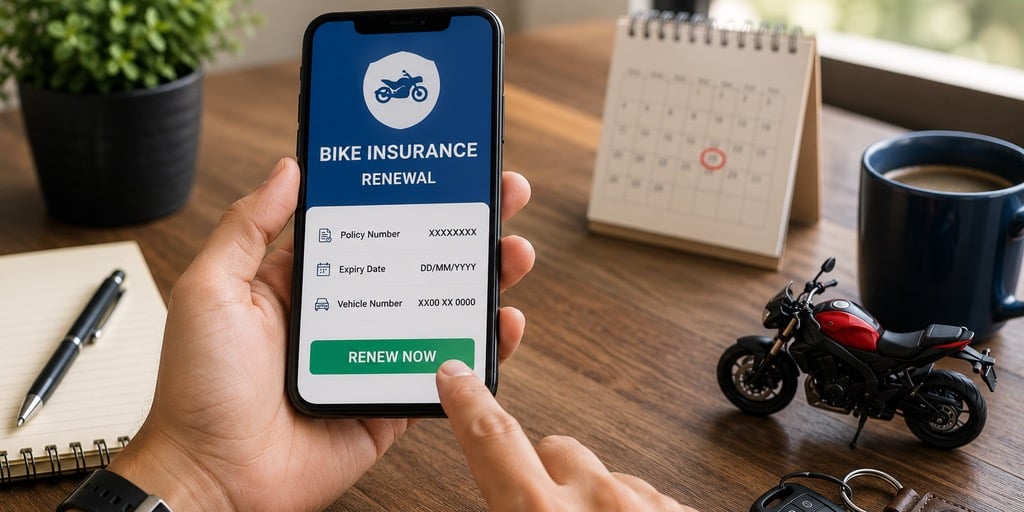
The Reliance two wheeler insurance renewal is fast online and needs very little paperwork. Here are the simple steps.
- Enter your bike and policy details on Insure24’s bike insurance page.
- Check your IDV, which drops a little each year as the bike ages.
- Pick your cover type and any add-ons you want.
- Apply your No-Claim Bonus, which carries over if you renew on time.
- Pay online and download your policy at once.
If your policy has already expired, you can still renew, but the bike may need a quick inspection first, which you can do through the Indusind app. Renew within the 120-day grace window that IRDAI allows, and you keep your No-Claim Bonus. Reliance offers an NCB that starts at 20% after one claim-free year and climbs to 50% after five. Let the policy lapse for too long and that discount resets to zero, so renew on time.
Claim Process
Reliance offers two ways to claim: cashless and reimbursement. Both are simple once you know the steps. A Reliance bike insurance claim can be started by phone or through the Indusind Insurance app.
For a cashless claim, call the Reliance helpline or use the Indusind Insurance app to register the claim. Note the time of the accident, take photos, and collect witness details if any. A surveyor checks the damage and approves the repair. Take the bike to a network garage, and the insurer pays the garage directly. You only cover your deductible and anything not included.
For a reimbursement claim, you repair the bike at a garage of your choice, pay the bill yourself, and send the bills to Reliance to get the approved amount back. For theft or an injury to someone else, file a police FIR straight away and submit the police certificate with your claim. Keep your policy, registration certificate, and driving licence ready for either route.
Reliance Bike vs Bajaj Allianz Bike
These two often come up together. Both are reliable, so the right pick depends on what you value most. The table below sets them side by side.
| Factor | Reliance | Bajaj Allianz |
|---|---|---|
| Price feel | Competitive, value-focused | Mid-market |
| Indusind Insurance app | Reliance Indusind Insurance | App with motor on-the-spot |
| Network reach | Good in Tier 1 and Tier 2 cities | Very wide, including smaller towns |
| Claim settlement | Healthy, reliable | Around high 90s |
| Best for | Riders chasing value | Riders wanting widest reach |
In short, Reliance bike insurance suits riders who want solid cover at a keen price, while Bajaj Allianz appeals to those who want the widest possible garage reach, especially outside metros. When riders weigh Reliance bike insurance vs Bajaj Allianz, it usually comes down to value against reach. Note that Bajaj Allianz rebranded to Bajaj General Insurance in late 2025, though its products and network carry on as before. Both keep their promises, so compare a quote on your own bike before you choose. A smooth Reliance bike insurance claim and a fair price are what most riders end up valuing most.
Reliance Bike Insurance: The Bottom Line
Reliance bike insurance is a strong, value-focused choice, especially if you want reliable cover without paying top-of-the-market prices. Its Indusind Insurance app makes claims and renewals quickly, its plans cover the events that matter, and its garage network reaches most cities. Compare a quote for your own bike, check for a network garage near you, and you will soon see if it is the right fit. For many riders, that mix of fair price and easy claims is exactly what they are after.
Note: This article has been vetted by Siddarth Khandelwal, an Insurance expert at Insure24.
FAQs
Q. How do I do a Reliance bike insurance renewal online?
Enter your bike and policy details on the insurer's site or a comparison platform, check your IDV, pick your cover and add-ons, apply your No-Claim Bonus, and pay. The policy downloads at once. For an on-time renewal, there is usually no inspection needed.
Q. Has Reliance General changed its name?
Yes. Reliance General Insurance rebranded to IndusInd General Insurance in late 2025 after a change in ownership. Your cover and the way you claim stay the same. Many riders still search for it as Reliance, and the products carry on unchanged.
Q. What is the Reliance two wheeler insurance renewal process after expiry?
You can renew a lapsed policy online, but the bike may need a quick inspection first, which you can do through the Indusind Insurance app. Renew within the 120-day grace window to keep your No-Claim Bonus. Beyond that, the bonus resets to zero.
Q. What is the Reliance two wheeler insurance claim process?
For a cashless claim, call the helpline or use the Indusind Insurance app, let a surveyor check the damage, and get the bike fixed at a network garage where the insurer pays directly. For reimbursement, you pay the garage and claim the amount back later. File an FIR for theft or third-party cases.
Q. How is my Reliance bike insurance premium decided?
The third-party part is fixed by IRDAI by engine size. The own-damage part of your Reliance bike insurance premium depends on your bike's IDV, age, city, and add-ons. Your No-Claim Bonus then lowers the final amount. Run a quote for your exact figure.
Q. Does Reliance two wheeler insurance offer cashless claims?
Yes. Reliance two wheeler insurance offers cashless claims at its network garages, where the insurer settles the bill directly and you pay only your deductible. Check that a network garage sits near you before you buy, so a cashless claim is easy if you need one.
Q. What add-ons does Reliance offer for bikes?
Reliance offers add-ons like zero depreciation, roadside assistance, and helmet cover, among others. Some plans also offer EMI protection if your bike is in repair for a long time. Pick the add-ons that fit your bike's age and how you ride.
Q. How good is Reliance for claims?
Reliance has a reliable claim record, and its Indusind Insurance app speeds things up by letting you start a claim and do a video inspection from your phone. Paired with a decent garage network, it is a solid choice for riders who want a quick, fuss-free claim.
Q. Is Reliance bike cover cheaper than other insurers?
Reliance is known for competitive, value-focused pricing on the own-damage part of the premium. The third-party part is fixed by IRDAI and the same everywhere. To know if it is cheapest for you, compare a quote on your own bike against a couple of rivals.
Q. Can I buy a long-term Reliance bike policy?
Yes. Reliance offers a long-term policy option, which lets you lock in cover for more than one year and skip annual renewals. This suits riders who would rather not keep track of yearly renewal dates. Compare the cost against a yearly plan before you decide.




Licenced by

COMPANY
PRODUCTS
RESOURCES
LEGAL
Cars24 Financial Services Private Limited
(Wholly owned subsidiary of Cars24 Services Private Limited)
Corporate Office - 6th Floor, SAS Tower-C, Ch Baktawar Singh Road, Medicity Sector 38, Shivaji Nagar,
Gurgaon - 122001, Haryana
IRDAI Corporate Agency Registration No: CA0710 | License Category: Composite |
CIN: U65990HR2018PTC075713
Disclaimer : The information contained in this website is presented purely for information purposes only provided as service to the internet community at large. It does not constitute insurance advice and we do not guarantee the accuracy, adequacy or the completeness of the information contained here.


Licenced by
COMPANY
PRODUCTS
RESOURCES
LEGAL
Cars24 Financial Services Private Limited
(Wholly owned subsidiary of Cars24 Services Private Limited)
Corporate Office - 6th Floor, SAS Tower-C, Ch Baktawar Singh Road, Medicity Sector 38, Shivaji Nagar,
Gurgaon - 122001, Haryana
IRDAI Corporate Agency Registration No: CA0710
License Category: Composite
CIN: U65990HR2018PTC075713
Disclaimer : The information contained in this website is presented purely for information purposes only provided as service to the internet community at large. It does not constitute insurance advice and we do not guarantee the accuracy, adequacy or the completeness of the information contained here.